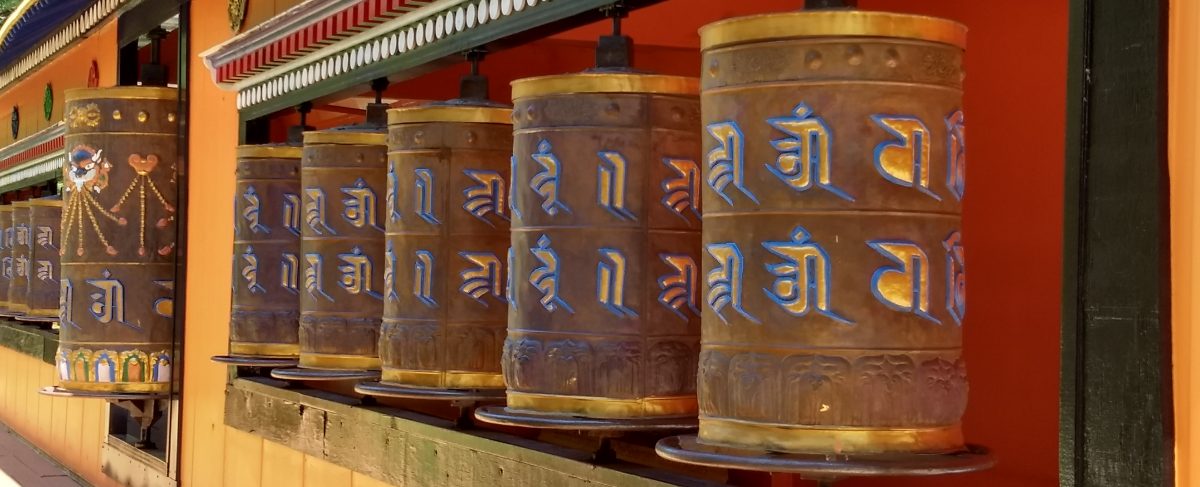
The End of Seeking?

These days on every corner you can find a teacher holding “satsang” and telling you that they have come to the end of seeking.

Ask them how they came to the end of seeking. Did they come to this realization without seeking, or did they first go through many trials and tribulations of seeking to finally arrive at the end of seeking.

And if they did, in fact, come through seeking, what is the value of telling others about their own non-seeking? Is it to brag? Are they not doing a disservice to those who are still in the midst of their journey? Should they not encourage others to continue to the end of their own seeking without trying to cut short the journey through some false non-existent short cut?

Or was it just some accidental happening, in which case, what is the value of telling others about that which is only a personal event and which cannot be reproduced?

There are probably many who have discovered their own inner landscape spontaneously, or even accidentally, but they are not of much help to others. No, rather than hang out with these satsang teachers, seek out the teachings of masters who are skilled at guiding others out of their delusions, confusions and misunderstandings. Once out of the quagmire, one finds the light shining with ever such splendor and it is then, and only then that seeking disappears.

-purushottama

Awakening is the Remedy – Osho

The state of ignorance is the cause of all delusions, of all unrealities, of all appearances, but to know more is not the state of knowledge. Ignorance is the cause, but knowledge is not the remedy — knowledge in the sense of knowledgeability. You can know more and more and more, but you remain the same. Knowledge becomes an addiction. You go on adding it. but the being to which you add it remains the same. You know more, but you are not more.

And the root cause of ignorance can be dissolved only when you are more, when your being is stronger, when your being is powerful, when your being has awakened. The root cause of all suffering is ignorance, but knowledge is not the remedy — awakening is the remedy.

If you don’t understand this subtle distinction, first, you are lost in ignorance, and then you will be lost — and lost more so — in knowledge. In the Upanishads there is one of the most radical statements ever uttered. The statement is that in ignorance people are lost, but in knowledge they are lost in a deeper way. Ignorance misguides, knowledge misguides more.

Ignorance is not absence of knowledge. If it was absence of knowledge then things would have been very, very easy — and cheap. You can borrow knowledge; you cannot borrow being. You can even steal knowledge; you cannot steal being. You have to grow into it. Remember this as a criterion: that unless you grow in something it is never yours. When you grow, only then something belongs to you. You may possess something but don’t be misguided by the possession. The possession remains separate — it can be taken away from you. Only your being cannot be taken away from you. So unless knowing happens into your being, ignorance cannot be dissolved.

Ignorance is not absence of knowledge; ignorance is absence of awareness. Ignorance is a sort of sleepiness, a sort of slumber, a sort of hypnosis; as if you are walking in sleep, doing things in deep sleep. You are not aware what you are doing. You are not a light; your whole being is dark. You can know about light, but that knowledge about light will never become light. On the contrary, it will become a hindrance toward light, because when you know too much about light, you forget that the light has not happened to you. You are deceived by your own knowledge.

It is as if you have been living in a dark cell. You have heard about light but you have not seen it. And how can you hear about light? It can only be seen. Ears are not the medium to know light: eyes are. And you have heard about light. And hearing again and again about light you have started to feel that you know light. You know about, but to know about, is not to know. You have heard. How can you hear light? It will be as if someone says that he has seen music. It will be absurd.

Hearing about light, the mind becomes more and more greedy. You consult scriptures. You go and seek wise, old men. You may even come across somebody who has seen, but the moment he says something about that, to you it becomes the heard. In India the oldest scriptures are known as shruti, that which has been heard. That’s beautiful. That’s really beautiful. How can truth be heard? And all the old scriptures are called shrutis, and smritis. Shruti means “the heard” and smriti means “the remembered.” You have heard and you remember. You have memorized it, but how can you know truth by hearing? You have to feel it. In fact, you have to live it.

The man living in the cave, in darkness, can collect many facts about light. He can almost become a great pundit. You can consult him and you can rely on him. He will say everything that has ever been said about light, but he will live all the same in darkness. And he cannot help you toward light; he himself is blind.

Jesus says again and again, “The blind are leading the blind.” Kabir says, “If you are suffering, become alert; you must have been led by a blind man. If blind people lead blind people, they fall in the well,” says Kabir. And you are all in the well of suffering; you must have heard too much about truth; you must have heard too much about God. Thousands of pulpits continuously preaching God — churches, temples, scholars — continuously talking “about.”

God is not a talk. It is an experience.

Ignorance cannot be dissolved by knowledge. It can be dissolved only by awareness. Knowledge you can go on collecting in the dream; but it is part of the dream, and the dream is part of your sleep. Somebody has to shake you. Somebody has to shock you. Somebody has to bring you out of your sleep; otherwise, you can go on and on. Sleep is alcoholic. Ignorance is alcoholic; it is a drug. You have to be pulled out of it.

I will tell you one anecdote I have always loved. It is about Siddha Naropa, the disciple of Tilopa. It happened before Naropa found his Master, Tilopa. It happened before he himself became enlightened. And it is a must for every seeker; it has to happen to everybody. So whether it happened to Naropa or not is not the point — it is a must on the journey. Unless it happens, enlightenment is not possible. So I don’t know historically whether it happened or not. Psychologically I am certain, absolutely certain it happened because nobody can move without it further into the beyond.

Naropa was a great scholar, a great pundit. There are stories that he was a great vice-chancellor of a great university — ten thousand disciples of his own. One day he was sitting surrounded by his disciples. All around him were scattered thousands of scriptures — ancient, very ancient, rare. Suddenly he fell asleep, must have been tired, and he had a vision. I call it a vision, not a dream, because it is no ordinary dream. It is so significant, to call it a dream won’t be just; it was a vision.

He saw a very, very old, ugly, horrible woman — a hag. Her ugliness was so much that he started trembling in his sleep. It was so nauseating he wanted to escape — but where to escape, where to go? He was caught, as if hypnotized by the old hag. Her body was nauseating, but her eyes were like magnets.

She asked, “Naropa, what are you doing?”

And he said, “I am studying.”

“What are you studying?” asked the old woman.

He said, “Philosophy, religion, epistemology, language, grammar, logic.”

The old woman asked again, “Do you understand them?”

Naropa said, “Of . . . Yes, I understand them.”

The woman asked again, “Do you understand the word or the sense?”

This was asked for the first time. Thousands of questions had been asked to Naropa in his life. He was a great teacher — thousands of students always asking, inquiring — but nobody had asked this: whether you understand the word or the sense. And the woman’s eyes were so penetrating that it was impossible to lie — she will find out. Before her eyes Naropa felt completely naked, nude, transparent. Those eyes were going to the very depth of his being. and it was impossible to lie. To anybody else he would have said. “Of course, I understand the sense,” but to this woman, this horrible-looking woman, he couldn’t speak the lie; he had to say the truth.

He said, “Yes, I understand the words.”

The woman was very happy. She started dancing and laughing.

Thinking that the woman has become so happy . . . And because of her happiness her ugliness was transformed; she was no longer so ugly; a subtle beauty started coming out of her being. Thinking, “I have made her so happy. Why not make her a little more happy?” he said, “And yes, I understand the sense also.”

The woman stopped laughing. She stopped dancing. She started crying and weeping, and all her ugliness was back — a thousandfold more.

Naropa said, “Why? Why are you weeping and crying? And why were you laughing and dancing before?”

The woman said, “I was dancing and laughing and was happy because a great scholar like you didn’t lie. But now I am crying and weeping because you have lied to me. I know — and you know — that you don’t understand the sense.”

The vision disappeared and Naropa was transformed. He escaped from the university. He never again touched a scripture in his life. He became completely ignorant: he understood that just by understanding the word, whom are you befooling? And just by understanding the word you have become an ugly old hag.

Knowledge is ugly. And if you go near scholars, you will find them stinking — of knowledge — dead.

A man of wisdom, a man of understanding, has a freshness about him, a fragrant life — totally different from a pundit from a man of knowledge. One who understands the sense becomes beautiful; one who only understands the word becomes ugly. And the woman was nobody outside: it was just a projection of the inner part. It was Naropa’s own being, through knowledge became ugly. Just this much understanding that “I don’t understand the sense,” and the ugliness was going to be transformed immediately into a beautiful phenomenon.

Naropa went in search because now scriptures won’t help. Now a living Master is needed. Then after long journeys he came across Tilopa. Tilopa was also in search of this man, because when you have something, you want to share, a compassion arises.

The Buddhist term for compassion is karuna. The English word does not carry exactly the same sense — it cannot carry. The word karuna is very, very meaningful. It comes from the same Sanskrit root as kriya. Kriya means action. Kriya and karuna — kriya means action, karuna means compassion — they both come from the same root kra. The Buddhist term karuna means “compassion in action.” And that is the difference between sympathy and compassion; when you are in sympathy there is no need for action — you simply show your sympathy and the thing is finished. Compassion is active — you do something. When you are really in compassion you will have to do something. How can you just be in sympathy? Sympathy will look so pale, so cold. Compassion is warm. Compassion means it has to be active.

When a man knows, compassion arises. Tilopa had known. He had come face to face with the ultimate: and now compassion arose. And he started seeking and searching for somebody who’ll be ready to receive . . . because you cannot throw this knowing of the ultimate before those who will not understand. A receptive heart, a feminine heart is needed. A disciple has to be feminine because the Master is to pour, and the disciple is just to allow.

They met and Tilopa said, “Naropa, now I will say everything that I have been waiting to say. I will say everything because of you, Naropa. You have come; now I can unburden myself.”

This vision of Naropa is very significant. This vision is a must. Unless you feel that knowledge is useless you will never be in search of wisdom. You will carry the false coin thinking that this is the real treasure. You have to become aware that knowledge is a false coin — it is not knowing, it is not understanding. At the most it is intellectual — the word has been understood but the sense lost. Once you understand this you will throw all your knowledge and you will escape in search of somebody who knows, because only with somebody who knows — heart to heart, being to being, the transfer happens. But if the disciple is already a man of knowledge the transfer is impossible because the knowledge will become the wall.

I can see a subtle wall around you always. Whenever you come to me I see whether I can approach you or not, whether you are approachable or not. If I see a very thick wall of knowledge it seems almost impossible to approach you; I will have to wait. If I can find even a small crack I enter from there. But scared people, full of fear — they don’t even leave a crack; they make a solid wall. They make a citadel around them of knowledge, knowing, concepts — abstract words. Futile! Just noise! In fact a nuisance, but you believe in them.

So this is the first thing to be understood: knowledge is not knowledge. And only that knowledge which is not knowledge but wisdom, understanding, knowing, can cut the roots of ignorance.

Remember the word “awareness.” Just as in the morning you become, by and by, alert and you come out of the sleep and the sleepiness falls down, disappears; the same happens again: you come out of your slumber; by and by your eyes open, you start seeing, your heart becomes available, your being open; and immediately, you are no longer the same person you were while asleep. Have you ever observed, in the morning, when awake, you become a totally different person — you are not the same who was asleep? Have you observed, in sleep you become a totally different person — in sleep you do things you cannot even imagine doing while you are awake — in sleep you believe in things you cannot believe while you are awake? In sleep every sort of absurdity is believed. While you are awake you laugh at your own foolishness, at your own dreams.

The same happens when you finally awake. Then, the whole world that you had lived in up to that moment becomes part of a dream, a great dream. That’s why Hindus go on saying the world is maya: the stuff it is made of is dream; it is not real. Awake! And you will find all those phantoms that surrounded you have disappeared. And a totally different vision of existence becomes available — that is freedom. Freedom is freedom from illusions. Freedom is freedom from sleep. Freedom is freedom from all that is not and appears to be there.

To come to the real is to come to home; to wander in unreality is to be in the world.

-Osho

From Yoga: A New Direction, Discourse #5; Yoga: Science of the Soul, V.5 (previously titled Yoga: The Alpha and the Omega, V.5)

Copyright © OSHO International Foundation

An MP3 audio file of this discourse can be downloaded from Osho.com, or you can read the entire book online at the Osho Library.

Many of Osho’s books are available in the U.S. online from Amazon.com and Viha Osho Book Distributors. In India they are available from Amazon.in and Oshoworld.com.

The Body is a Great Organic Unity – Osho

Austerities destroy impurities, and with the ensuing perfection in the body and sense organs, physical and mental powers awaken.

Union with the divine happens through self-study.

Total illumination can be accomplished by surrendering to God.

-Patanjali’s Yoga Sutras

Man is like an iceberg: only a part, a minor part, is visible on the surface; the major part of the whole is hidden beneath. Or, man is like a tree: the real life is in the roots, hidden underground; only branches are visible. If you cut the branches, new branches will come up because branches are not the source; but if you cut the roots the tree is destroyed. Only a part of man is visible on the surface; the major part is hidden behind. And if you think that the visible man is all, then you commit a great mistake. Then you miss the whole mystery of man; and then you miss the doors within yourself which can lead you towards the divine.

If you think that by knowing the name of a person, by knowing from which family he comes, by knowing his profession, that he is a doctor or an engineer or a professor, or by knowing his face, his picture, you have known him; you are in great illusion. These are just the appearances on the surface. The real man is far, far away from all these. This way you may be acquainted, but you never know the man. It is enough as far as society is concerned; more is not needed. This skin-deep knowledge is enough for the marketplace, but if you really want to know the man then you have to go deep. And the only way to go deep is to go within yourself first.

Unless you know the unknown within you, you will never be able to know anybody else. The only way to know the mystery that man is, is to know the mystery that you are. There are hidden layers behind hidden layers. Man is infinity.

If you go on diving deep in man you will reach to God. Man is just the surface of the ocean, waves. If you dive deep you reach to the very center of existence. Those who have known God — they have not known him as an object. They have known him as their innermost subjectivity. Those who have known God have not encountered him. They have not seen him as an object; they have seen him as the very seer, as their own consciousness. You cannot encounter God anywhere except within yourself. He is your depth; you are his surface. You are his periphery; he is your center.

And the deeper you move within yourself, the deeper you are moving in the whole existence, in others also, because the center is one. Peripheries are millions, but the center is one. The whole existence is centered on one point — that one point is God. God: that is the deepest depth of being.

It is a great journey, a great pilgrimage to know man. Patanjali’s sutras give you clues how to enter.

The first sutra:

Kayendriya siddhih ashuddhih ksyayat tapasah.

Austerities destroy impurities, and with the ensuing perfection in the body and sense organs, physical and mental powers awaken.

Before you can understand this sutra, many more things have to be understood. The body has been very much misused. You have mistreated your own body. You don’t know the mystery of the body itself. It is not just the skin; it is not just the bones; it is not just the blood. It is a great organic unity, a great dynamism.

For centuries man thought that blood filled the body as water fills a container. Only just three centuries ago, we came to know that blood does not fill the body, that it is not a stagnant thing — blood circulates. Only just three centuries ago, we came to know that blood circulates, it is a dynamic force. It does not fill the body, but it circulates — so silently and so continuously, and the movement is so graceful, without any noise, that we have lived with bodies for millions of lives and we have never come to encounter the reality of the blood, that it circulates.

There are many more mysteries which are hidden. This body is just the first layer of many bodies — in all, seven bodies. If you move deep in this body, you will come across new phenomena. Behind this gross body is hidden the subtle body. Once that subtle body awakes, you become very powerful because you attain to certain new dimensional forces. This body can lie down in your bed, and your subtle body can move. For it there is no barrier. The gravitation of the earth does not affect it; there is no barrier of time and space for it. It can move . . . it can move anywhere. The whole world is open for it. For the gross body that is not possible.

In some of your dreams the subtle body actually leaves your physical body. In some of your deep meditations your subtle body leaves your physical body. Many of you, deeply meditating, sometimes have become aware that it feels as if you have risen above the earth, a few inches, a few feet. When you open your eyes you are sitting on the earth. You think you have imagined it. It is not so. The subtle body, in deep meditation, can go a little higher than your gross body. Sometimes that, too, happens — that the gross body also follows the subtle body.

There is a woman in Europe; she has been investigated by all the scientific methods. In deep meditation she rises four feet above the earth; not only in the subtle body, but the gross body also. It has been found to be a fact. This is said in the oldest yoga treatises: that in deep meditation it happens that with the subtle body the gross body can go above the ground — and, exactly, it says it can go four feet very easily.

And the gross body is just the surface body, the skin of other bodies. Then behind the subtle there are subtler bodies — in all, seven bodies. They all belong to seven different planes of being. The more you enter in your own being, the more you become aware that this body is not the all. But you will encounter the second body only if this body has become pure.

Yoga does not believe in torturing the body, it is not a masochistic affair — but it believes in purifying it. And, sometimes, purifying it and torturing it may look alike. A distinction has to be made. A man can fast, and he may be only torturing. He may be just against his own body, suicidal, masochistic. But then another man can fast and he may not be a torturer, and he may not be a masochist, and he may not be trying to destroy the body in any way. Rather, he may be trying to purify it. Because in deep fasting, body attains to certain purities.

You continuously go on eating every day; you never give any holiday to the body. The body goes on accumulating many dead cells — they become a load. Not only are they a load and a burden, they are toxins, they are poisonous. They make the body impure. When the body is impure you cannot see the hidden body behind it. This body needs to be clean, transparent, pure; then suddenly you become aware of the second layer, the subtle body. When the subtle body is pure then you become aware of the third body, and the fourth, and so on.

Fasting helps tremendously, but one needs to be very much aware that one is not destroying the body. No condemnation should be in the mind; and there is the problem because almost all religions have condemned the body. Their original founders were not condemners; they were not poisoners. They loved their bodies. They loved the body so much that they always tried to purify it. Their fasting was a purification.

Then came blind followers, unaware of the deep science of fasting. They started fasting, blindly. They enjoyed, because mind is violent. It enjoys being violent with others, it enjoys the power, because whenever you are violent with others you feel powerful; but to be violent with others is risky because the other will retaliate. Then there is a simple way: to be violent with your own body. Then there is no risk. The body cannot retaliate. The body cannot harm you. You can go on harming your own body; there is nobody to react. This is simple. You can torture and enjoy power — that now you control your body; the body doesn’t control you.

If this fasting is aggressive, violent, if there is anger and destructiveness, then you miss the point. You are not purifying the body; you are in fact destroying it.

And to clean a mirror is one thing and to destroy the mirror is another. To clean the mirror is totally different, because when the mirror is clean of all dust, pure, you will be able to look into it — it will reflect you. But if you destroy the mirror, then there is no possibility to look into it. If you destroy the gross body, you lose all possibility of contact with the second, the subtle body. Purify it, but don’t be destructive.

And how does fasting purify? Because whenever you are on a fast the body has no more work of digestion. In that period the body can work in throwing out dead cells, toxins. It is just as [if] one day, Sunday or Saturday, you are on a holiday and you come home and you clean the whole day. The whole week you were so engaged and so busy you couldn’t clean the house. When the body has nothing to digest, you have not eaten anything, the body starts a self-cleaning. A process starts spontaneously, and the body starts throwing out all that is not needed, which is like a load. Fasting is a method of purification. Once in a while, a fast is beautiful — not doing anything, not eating, just resting. Take as much liquid as possible and just rest, and the body will be cleaned.

Sometimes, if you feel that a longer fast is needed, you can do a longer fast also — but be deep in love with the body. And if you feel the fast is harming the body in any way, stop it. If the fast is helping the body, you will feel more energetic; you will feel more alive; you will feel rejuvenated, vitalized. This should be the criterion: if you start feeling that you are getting weaker, if you start feeling that a subtle trembling is coming into the body, then be aware — now the thing is no longer a purification. It has become destructive. Stop it.

But one should learn the whole science of it. In fact one should do fasting near somebody who has been fasting for long and who knows the whole path very well, who knows all the symptoms: if it becomes destructive what will start happening; if it is not destructive then what will happen. After a real, purifying fast you will feel new, younger, cleaner, weightless, happier; and the body will be functioning better because now it is unloaded. But fasting comes only if you have been eating wrongly. If you have not been eating wrongly there is no need for fasting. Fasting is needed only when you have already done the wrong with the body — and we all have been eating wrongly.

Man has lost the path. No animal eats like man; every animal has its chosen food. If you bring buffaloes in the garden and leave them, they will eat only a particular grass. They will not go on eating everything and anything — they are very choosey. They have a certain feeling about their food. Man is completely lost, has no feeling about his food. He goes on eating everything and anything. In fact you cannot find anything which is not eaten somewhere or other by man. In some places, ants are eaten. In some places, snakes are eaten. In some places, dogs are eaten. Man has eaten everything. Man is simply mad. He does not know what is in resonance with his body and what is not. He is completely confused.

Man, naturally, should be a vegetarian, because the whole body is made for vegetarian food. Even scientists concede to the fact that the whole structure of the human body shows that man should not be a nonvegetarian. Man comes from the monkeys. Monkeys are vegetarians — absolute vegetarians. If Darwin is true then man should be a vegetarian. Now there are ways to judge whether a certain species of animal is vegetarian or nonvegetarian: it depends on the intestine, the length of the intestine. Nonvegetarian animals have a very small intestine. Tigers, lions — they have a very small intestine, because meat is already a digested food. It does not need a long intestine to digest it. The work of digestion has been done by the animal. Now you are eating the animal’s meat. It is already digested — no long intestine is needed. Man has one of the longest intestines: that means man is a vegetarian. A long digestion is needed, and much excreta will be there which has to be thrown out.

If man is not a nonvegetarian and he goes on eating meat, the body is burdened. In the East, all the great meditators — Buddha, Mahavir — they have emphasized the fact. Not because of any concept of nonviolence — that is a secondary thing — but because if you really want to move in deep meditation your body needs to be weightless, natural, flowing. Your body needs to be unloaded; and a nonvegetarian’s body is very much loaded.

Just watch what happens when you eat meat: when you kill an animal what happens to the animal when he is killed? Of course, nobody wants to be killed. Life wants to prolong itself; the animal is not dying willingly. If somebody kills you, you will not die willingly. If a lion jumps on you and kills you, what will happen to your mind? The same happens when you kill a lion. Agony, fear, death, anguish, anxiety, anger, violence, sadness — all these things happen to the animal. All over his body — violence, anguish, agony spreads. The whole body becomes full of toxins, poisons. All the body glands release poisons because the animal is dying very unwillingly. And then you eat the meat — that meat carries all the poisons that the animal has released. The whole energy is poisonous. Then those poisons are carried in your body.

And that meat which you are eating belonged to an animal body. It had a specific purpose there. A specific type of consciousness existed in the animal’s body. You are on a higher plane than the animal’s consciousness, and when you eat the animal’s meat your body goes to the lowest plane, to the lower plane of the animal. Then there exists a gap between your consciousness and your body, and a tension arises, and anxiety arises.

One should eat things which are natural — natural for you. Fruits, nuts, vegetables — eat as much as you can. And the beauty is that you cannot eat these things more than is needed. Whatsoever is natural always gives you a satisfaction, because it satiates your body, saturates you. You feel fulfilled. If something is unnatural it never gives you a feeling of fulfillment. Go on eating ice cream: you never feel that you are satiated. In fact the more you eat, the more you feel like eating. It is not a food. Your mind is being tricked. Now you are not eating according to the body need; you are eating just to taste it. The tongue has become the controller.

The tongue should not be the controller. It does not know anything about the stomach. It does not know anything about the body. The tongue has a specific purpose to fulfill: to taste food. Naturally, the tongue has to judge, that is the only thing, which food is for the body — for my body — and which food is not for my body. It is just a watchman on the door; it is not the master. And if the watchman on the door becomes the master, then everything will be confused.

Now advertisers know well that the tongue can be tricked, the nose can be tricked. And they are not the masters. You may not be aware: much food research goes on in the world, and they say if your nose is closed completely, and your eyes closed, and then you are given an onion to eat, you cannot tell what you are eating. You cannot tell onion from apple if the nose is closed completely because half of the taste comes from the smell, is decided by the nose, and half is decided by the tongue — and these two have become the controllers. Now they know whether ice cream is nutritious or not is not the point. It can carry a flavor; it can carry some chemicals which fulfill the tongue but are not needed for the body.

Man is confused — more confused than buffaloes. You cannot convince buffaloes to eat ice cream. Try!

A natural food . . . and when I say “natural” I mean that which your body needs. The need of a tiger is different; he has to be very violent. If you eat the meat of a tiger you will be violent, but where will your violence be expressed? You have to live in human society, not in a jungle. Then you will have to suppress the violence. Then a vicious circle starts.

When you suppress violence, what happens? When you feel angry, violent, a certain poisonous energy is released, because that poison creates a situation where you can be really violent and kill somebody. The energy moves towards your hands; the energy moves towards your teeth — these are the two places from where animals become violent. Man is part of the animal kingdom.

When you are angry, energy is released — it comes to the hands and to the teeth, to the jaw — but you live in a human society, and it is not always profitable to be angry. You live in a civilized world, and you cannot behave like an animal. If you behave like an animal, you will have to pay too much for it — and you are not ready to pay that much. Then what do you do? You suppress the anger in the hand; you suppress the anger in your teeth — you go on smiling a false smile, and your teeth go on accumulating anger.

I have rarely come to see people with a natural jaw. It is not natural — blocked, stiff — because too much anger is there. If you press the jaw of a person, the anger can be released. Hands become ugly. They lose grace, they lose flexibility, because too much anger is suppressed there. People who have been working on deep massage, they have come to know that when you touch the hands deeply, massage the hands, the person starts becoming angry. There is no reason. You are massaging the man and suddenly he starts feeling angry. If you press the jaw, persons become angry again. They carry accumulated anger.

These are the impurities in the body: they have to be released. If you don’t release them the body will remain heavy. Yoga exercises exist to release all sorts of accumulated poisons in the body. Yoga movements release them; and a yogi’s body has a suppleness of its own. Yoga exercises are totally different from other exercises. They don’t make your body strong; they make your body more flexible. And when your body is more flexible, you are strong in a very different sense: you are younger. They make your body more liquid, more flowing — no blocks in the body. The whole body exists as an organic unity, in a deep rhythm of its own. It is not like noise in the market; it is like an orchestra. A deep rhythm inside, no blocks, then the body is pure. Yoga exercises can be tremendously helpful.

Everybody is carrying much rubbish in the stomach because that is the only space in the body where you can suppress things. There is no other space. If you want to suppress anything it has to be suppressed in the stomach. If you want to cry — your wife has died, your beloved has died, your friend has died — but it doesn’t look good, looks as if you are a weakling, crying for a woman, you suppress it: where will you put that crying? Naturally, you have to suppress it in the stomach. That is the only space available in the body, the only hollow place, where you can force.

If you suppress in the stomach . . . And everybody has suppressed many sorts of emotions: of love, of sexuality, of anger, of sadness, of weeping — even of laughter. You cannot laugh a belly laugh. It looks rude, looks vulgar — you are not cultured then. You have suppressed everything. Because of this suppression, you cannot breathe deeply, you have to breathe shallowly. Because if you breathe deeply then those wounds of suppression, they would release their energy. You are afraid. Everybody is afraid to move in the stomach.

Every child, when born, breathes through the belly. Look at a child sleeping: the belly goes up and down — never the chest. No child breathes from the chest; they breathe from the belly. They are completely free now, nothing is suppressed. Their stomachs are empty, and that emptiness has a beauty in the body.

Once the stomach has too much suppression in it, the body is divided in two parts, the lower and the higher. Then you are not one; you are two. The lower part is the discarded part. The unity is lost; a duality has entered into your being. Now you cannot be beautiful, you cannot be graceful. You are carrying two bodies instead of one — and there will always remain a gap between the two. You cannot walk beautifully. Somehow you have to carry your legs. In fact if the body is one, your legs will carry you. If the body is divided in two then you have to carry your legs.

You have to drag your body. It is like a burden. You cannot enjoy it. You cannot enjoy a good walk, you cannot enjoy a good swim, you cannot enjoy a fast run — because the body is not one. For all these movements, and to enjoy them, the body needs to be reunited. A unison has to be created again: the stomach will have to be cleansed completely.

For the cleansing of the stomach, very deep breathing is needed, because when you inhale deeply and exhale deeply, the stomach throws all that it is carrying. In exhalations, the stomach releases itself. Hence the importance of pranayam, of deep rhythmic breathing. The emphasis should be on the exhalation so that everything that the stomach has been unnecessarily carrying is released.

And when the stomach is not carrying emotions inside, if you have constipation, it will suddenly disappear. When you are suppressing emotions in the stomach, there will be constipation because the stomach is not free to have its movements. You are deeply controlling it; you can’t allow it freedom. So if emotions are suppressed, there will be constipation. Constipation is more a mental disease than a physical one. It belongs to the mind more than it belongs to the body.

But remember, I am not dividing mind and body in two. They are two aspects of the same phenomenon. Mind and body are not two things. In fact to say “mind and body” is not good: “mind-body” will be the right expression. Your body is a psychosomatic phenomenon. Mind is the subtlest part of the body, and body is the grossest part of the mind. And they both affect each other; they run parallel. If you are suppressing something in the mind, the body will start a suppressing journey. If the mind releases everything, the body also releases everything. That’s why I emphasize catharsis very much. Catharsis is a cleansing process.

These are all austerities: fasting; natural eating; deep, rhythmic breathing; yoga exercises; living a more and more natural, flexible, supple life; creating less and less suppressed attitudes; allowing the body to have its own say, following the wisdom of the body. “Austerities destroy impurities . . .” These I call austerities. “Austerities” does not mean to torture the body. It means to create a living fire in the body so that the body is cleansed. As if you have thrown gold into the fire — all that was not gold is burned. Only pure gold comes out.

Austerities destroy impurities, and with the ensuing perfection in the body and sense organs, physical and mental powers awaken.

When the body is pure, you will see tremendous new energies arising, new dimensions opening before you, new doors suddenly opening, new possibilities. Body has much hidden power. Once it is released, you will not be able to believe it, that the body carried so many things in it, and so close.

And every sense has a hidden sense behind it. Eyes have a hidden eyesight, an insight behind them. When the eyes are pure, clean, then you don’t see things only as they are on the surface. You start seeing their depth. A new dimension opens. Right now when you see a person you don’t see his aura; you just see his physical body. The physical body is surrounded by a very subtle aura. A diffused light surrounds the body. And everybody’s body is surrounded by a different color aura. The moment your eyes are clean you can see the aura; and by seeing the aura you know many things about the man that you cannot know in any other way. And the man cannot deceive you, it is impossible, because his aura reveals his being.

Somebody comes with an aura of dishonesty and he tries to convince you that he is a very honest man: the aura cannot deceive because that man cannot control the aura. That is not possible. The dishonest aura has a different color. The aura of an honest man has a different color. The aura of a pure man is pure white. The more impure a man, the more white moves towards gray. The more impure, it moves still more towards black. The aura of a man who is absolutely dishonest is absolutely black. The aura of a confused man changes; it is never the same. Even if you go on looking for just a few minutes, you will see the aura is changing. The man is confused. He himself is not settled in what he is. He is a changing aura.

A man who is meditative has a very silent quality to the aura, a calmness, a coolness around him. The man who is in deep anxiety, turmoil, tension, has the same quality to the aura also. The man who is very tense may try smiling, may create a face, may have a mask, but when he comes to you his aura will show the reality.

And the same happens with the ears also. Just as eyes have a deep insight, the ears have a deep hearing quality. Then you don’t hear what the man is saying, but rather, you hear the music. You don’t bother about the words that he is using, but the tone, but the rhythm of his voice . . . an inner quality of the voice which says many things which words cannot deceive, cannot change. The man may be trying to be very polite, but his rudeness will be in his sound. The man may be trying to be very graceful, but his sound will show his ungracefulness. The man may be trying to show his certainty, but his sound will show the . . . the hesitant quality.

And if you can hear the very sound, and if you can see the aura, and if you can feel the quality of the being that is near you, you become capable of many things. And these are very simple things. They start happening once the austerity starts.

Then there are deeper powers which yoga calls siddhis — magical powers, miraculous powers. They look like miracles because we don’t understand their mechanism, how they function. Once you know the mechanism, they are not miracles. In fact a miracle is not possible. All that happens, happens according to a law. The law may not be known, then you call it a miracle. When the law is known, the miracle disappears.

Just now in India they have introduced television in the villages. For the first time, villagers have watched Indira Gandhi in the television boxes, as the villagers call them — “picture boxes.” They could not believe. Impossible. They went around the boxes, they looked from everywhere. How is Indira Gandhi hidden in the box? A miracle, unbelievably miraculous, but once you know the law the thing is simple.

All miracles are according to hidden laws. Yoga says there is no miracle in the world because “miracle” means something against the law, which is not possible.

How is there any possibility to go against the universal law? There is no possibility. It may be people don’t know.

Siddhis become possible as you go deeper into purities and perfection. For example, if you can move your astral body out of the gross body you can do many things which will be miraculous. You can visit people. They can see you but they cannot touch you. You can even talk to them by your astral projection. You can heal people. If you are really pure, just your touch, laying on of the hands, and there will be a miracle. Just surrounding you will be the healing power — wherever you will move, healing will happen automatically. Not that you do it. The very purity . . . you have become a vehicle of the infinite forces.

But one has to move withinwards, one has to search one’s own innermost core.

Austerities destroy impurities, and with the ensuing perfection in the body and sense organs, physical and mental powers awaken.

And the greatest power that awakens in you is the feeling of deathlessness. Not that you have a theory, a system, a philosophy that you are immortal, no. Now you have a feeling, now you are grounded in it — now you know it. It is not a question of any theory: it has become your knowing that there is no death. This body will disappear into its elements, but your consciousness cannot disappear. The mind will disintegrate, the thoughts will be released, the body will go into the elements — but you, the witnessing self, will remain.

You know it because now you can see your body from the far, faraway space. You can see your body separate from you. You can come out of the body and look at it. You can move around your own body. Now you know that the body will be left when you die, but not you. Now you can see the mind functioning as a mechanism, as a biocomputer. You are the seer, not the mind. Now the body and mind go on functioning, but you are not identified.

This is the greatest miracle that can happen to a man: that he comes to know that he is deathless. Then the fear of death disappears, and with the fear of death, all fears disappear.

And when fears disappear, love arises. When there is no fear, love arises; only then love arises. How can love arise in a fear-ridden mind? You may seek friendship, you may seek a relationship, but you seek it out of fear — to forget yourself, to drown yourself in the relationship. It is not love. Love arises only when you have transcended death. They both cannot exist together: if you are afraid of death, how can you love? Out of this fear you may try to find company, but the relationship will remain of fear.

That’s why ninety-nine per cent of religious people pray, but their prayer is not real prayer. It is not out of love; it is out of fear. Their God is out of the fear. Only rarely, one per cent of religious persons come to realize deathlessness. Then a prayer arises which is not out of fear, which is out of love, sheer gratitude, a thankfulness.

Swadhyayat istadevata samprayogah.

Union with the divine happens through self-study — swadhyaya.

This is a very important sutra: “Union with the divine happens through self- study.” One has to study oneself — that is the only way to reach the divine. Patanjali does not say, “Go to the temple.” He does not say, “Go to the church.” He does not say, “Do the rituals.” No, that is not the way to be one with the divine. Go into yourself — swadhyaya, self-study — because he is hidden behind you, within you. He is your withinmost core. You are the temple; go within. Study yourself. You are a tremendous phenomenon — study yourself. Study all that you are. And the day you have studied yourself completely, he will be revealed. He is hidden behind you, within you. He is you in your deepest being. So study yourself.

This “study” means actually what Gurdjieff means by “self-remembering.” Patanjali’s swadhyaya is exactly what Gurdjieff means by “self-remembering.” Remember yourself and just go on watching. How you relate with people — watch. Relationship is a mirror. How you relate with strangers, how you relate with people who are known to you, how you relate with your servant, how you relate with your boss — just go on watching. Let every relationship be a mirror, a reflection, and watch how you change your mask. Look at your greed, look at your jealousies, look at your fear, look at your anxieties, possessiveness — go on looking and watching.

There is no need to do anything! That’s the beauty of the sutra. Patanjali does not say, “Do something!” He says, “Study yourself.” The very study, the very awareness will do. A transformation will happen when you come face to face to know your whole being.

In different moods: when you are sad — watch; when you are happy — watch; when you are indifferent — watch; when you are feeling hopeless — watch; when you are filled with hope so much — watch; in desire, in frustration . . .  There are millions of moods around you — go on watching. Let every mood be a window to look within yourself. From all colors of the rainbow, watch yourself. When you are alone — watch. When you are not alone — watch. Move to the mountains, isolated — watch. Go to the factory, to the office — watch how you change, where you change.

If you go on watching . . . Never relax this watching for a single moment. Buddha has said, “Then when you go to your bed — go on watching. When you go on, falling into sleep — go on watching how you fall asleep.” Go on watching. Don’t allow anything to pass without watching. Just this self-remembering, this self-study, will do all. You need not ask, “What do I do after I have watched?” Nothing is needed. Once you watch your hatred totally, it disappears.

And this is the criterion: that which disappears by watching is sin, and that which grows by watching is virtue. That’s the only definition I can give to you. I don’t say that “this is sin and that is virtue.” No, sin and virtue cannot be objectified. That which grows by watching is virtue; that which disappears by watching is sin. Anger will disappear by watching; love will grow. Hatred will disappear; compassion will grow. Violence will disappear; prayer will grow, gratitude will grow. So whatsoever disappears through watching is sin. Nothing else is needed to be done with it. Just watch it and it disappears. It disappears just as when you bring light to a dark room the darkness disappears. The room does not disappear; the darkness disappears.

You will not disappear by watching. In fact, by watching, you will be revealed. Only darkness will disappear: the darkness of anger, the darkness of possessiveness, the darkness of jealousy — all that will disappear. Only you will be left in your pristine purity. Only your inner space will be left — empty, void.

Union with the divine happens through self-study. Nothing else is needed — awareness.

Samadhi siddha Ishwar pranidhanat.

Total illumination can be accomplished by surrendering to God.

And when you have studied yourself, when you have come to know yourself . . . surrender. That becomes very simple. It is not an effort then. Now if you want to surrender, it will be a tremendous effort; and then too it will never be total. If right now you want to surrender, how can you surrender with hatred inside? How can you surrender with jealousy inside? How can you surrender with violence inside? Surrender is possible only when you are absolutely pure.

How can you go to God and put your hatred, violence, jealousies at his feet? No, only when you are pure, a flower of purity — then you enter the temple and surrender it.

To surrender, one should become worthy of it, because surrender is the greatest act. Nothing is beyond it. You cannot surrender by your will and effort, because will and effort belong to the ego. The ego cannot surrender. When you go on studying yourself, watching yourself, the ego disappears. You remain, but there is no longer the “I.” You are a vast emptiness — with no “I” in it. You are a vast amness, but no “I” in it. Being exists, ego no more — then it is possible to surrender.

Total illumination can be accomplished by surrendering to God.

Total illumination, samadhi: you become light itself. Everything disappears. You remain as energy; and the purest energy is light. Now scientists, physicists, say that if anything is moved at the speed of light it will become light. If a stone brick is thrown at the speed of light, the brick will disappear. It will become light itself because at that speed things disappear; only energy remains. They have discovered it just now, within this century, that there is a possibility that all matter is convertible into light, into energy. Matter is a slow-speed energy; light is a high-speed energy.

Ego is a material thing; it is a slow-speed energy. When you surrender it, you attain to the speed of light. Then you are no longer a solid thing: then you are weightless energy. And weightless energy has no limitation; it is unlimited. And weightless energy cannot be defined in any other way — the only way is to say that it is light. The Bible says, “God is light.” The Koran says, “God is light.” The Upanishads say, “God is light.” You become light.

Total illumination can be accomplished by surrendering to God.

First, move through self-study so you can encounter God within. Then surrender to it. All and all that you are — surrender to it. And remember, that surrendering is not an effort, so don’t be bothered about how to surrender. Just first remember yourself; surrendering comes as a shadow. There is no technique to surrender. Once you know yourself, you know now how to bow down and surrender yourself. Surrendered, you become God himself. Fighting with the whole, you remain an ugly ego. Surrendered with the whole, you become the whole. Let go is the ultimate mantra.

But the greed may arise in your mind: “Then why wait? Why should I not surrender now?” You cannot. You are the barrier, so how can you surrender? When you are not, surrender will be. If you are, surrender is not possible. You will not surrender; your disappearance will be the surrender. You go out of one door; from another door enters surrender. You and surrender cannot exist together.

So remember, you cannot surrender. Watch yourself, so you become purer and purer and purer — so pure that almost nothing is left, only a purity, a fragrance — then surrender happens.

In this sutra Patanjali is simply saying that total illumination can be accomplished by surrendering to God. He is not saying how to surrender. He is not saying that surrender has to be done. He is simply indicating a phenomenon. Self-study has to be done; you will come face to face with God. If you have done self-study, you enter the temple, you face God, and then there is no problem. The moment you face him surrender happens. It is not a doing; it is a happening.

-Osho

From The Essence of Yoga, Discourse #5, Yoga: Science of the Soul. V.6 (previously titled Yoga: The Alpha and the Omega, V.6).

Copyright © OSHO International Foundation

This discourse is the Listening Meditation in the ninth program of the module, Osho Yoga and the Discipline of Transformation, one of several modules in A Course in Witnessing.

An MP3 audio file of this discourse can be downloaded from Osho.com or you can read the entire book online at the Osho Library.

Many of Osho’s books are available in the U.S. online from Amazon.com and Viha Osho Book Distributors. In India they are available from Amazon.in and Oshoworld.com.

Beyond the Gateless Gate: Transcending the Seven Bodies, Part 2 – Osho

Raja yoga begins with the fourth body. Only hatha yoga begins with the first body; other yogas begin from somewhere else. Theosophy begins from the second body, and other systems begin from the third. As civilization goes on progressing to the fourth body, many persons will be able to begin from there. But only if they have worked through the three lower bodies in their past lives can the fourth be used. Those who study raja yoga from scriptures or from swamis and gurus without knowing whether or not they have worked through their three lower bodies are bound to be disillusioned because one cannot begin from the fourth. The three must be crossed first. Only then does the fourth come.

The fourth is the last body that it is possible to begin from. There are four yogas: hatha yoga for the first body, mantra yoga for the second, bhakti yoga for the third, and raja yoga for the fourth. In ancient days, everybody had to begin with the first body, but now there are so many types of people: one has worked up to the second body in a previous life, another up to the third, et cetera. But as far as dreaming is concerned, one must begin from the first body. Only then can you know the whole range of it, the whole spectrum of it.

So in the fourth body, your consciousness must become like fire – going upward. There are many ways to check this. For example, if the mind is flowing toward sex it is just like water flowing downward, because the sex center is downward. In the fourth body one must begin directing the eyes up, not down.

If consciousness is to go upward, it must begin from a center that is above the eyes, not below the eyes. There is only one center above the eyes from which the movement can be upward: the ajna chakra. Now the two eyes must look upward toward the third eye.

The third eye has been remembered in so many ways. In India, the distinction between a virgin and a girl who is married is made by a color mark on the third eye of the married one. A virgin is bound to look downward toward the sex center, but the moment she is married she must begin to look upward. Sex must change from sexuality to beyond sexuality. To help her to remember to look upward, a color mark, a tilak, is used on the third eye.

Tilak marks have been used on the foreheads of so many types of persons: sannyasins, worshippers – so many types of color marks. Or it is possible to use chandan – sandalwood paste. The moment your two eyes look upward toward the third eye, a great fire is created at the center; a burning sensation is there. The third eye is beginning to open, and it must be kept cool. So in India, sandalwood paste is used. It is not only cool; it also has a particular perfume that is concerned with the third body and the transcendence of it. The coolness of the perfume, and the particular spot where it is placed, becomes an upward attraction, a remembrance of the third eye.

If you close your eyes and I place my finger at your third eye spot, I am not really touching your third eye itself, but you will still begin to feel it. Even this much pressure is enough. Scarcely a touch, just a gentle fingering. So the perfume, the delicate touch of it and its coolness, is enough. Then your attention is always flowing from your eyes to the third eye.

So to cross the fourth body there is only one technique, one method, and that is to look upward.

Shirshasan, the headstand, the reverse position of the body, was used as a method to do this because our eyes are ordinarily looking downward. If you stand on your head, you will still be looking downward, but now the downward is upward. The flow of your energy downward will be converted into an upward flow.

That is why in meditation, even without knowing it, some persons will go into reverse positions. They will begin to do shirshasan because the flow of energy has changed. Their minds are so conditioned to the downward flow that when the energy changes direction they will feel uncomfortable. When they begin to stand on their heads they will feel at ease again, because the flow of energy will again be moving downward. But it will not really be moving downward. In relation to your centers, your chakras, the energy will still be moving upward.

So shirshasan has been used as a method to take you from the fourth body to the fifth. The main thing to be remembered is to be looking upward. This can be done through tratak – staring at a fixed object, through concentration on the sun, through so many objects. But it is better to do it inwardly. Just close the eyes!

But first, the first four bodies must be crossed. Only then can it be helpful, otherwise not. Otherwise, it may be disturbing; it may create all sorts of mental diseases, because the whole adjustment of the system will be shattered. The four bodies are looking downward, and with your inner mind you are looking upward. Then, there is every possibility that schizophrenia will result.

To me, schizophrenia is the result of such a thing. That is why ordinary psychology cannot go deeply into schizophrenia. The schizophrenic mind is simultaneously working in opposite directions: standing outside and looking inside; standing outside and looking upward. Your whole system must be in harmony. If you have not known your physical body from the inside, then your consciousness should be facing downward. That will be healthy; the adjustment is right. You must never try to turn the outward moving mind upward or schizophrenia, division, will be the result.

Our civilizations, our religions, have been the basic cause for humanity’s split personality. They have not been concerned with the total harmony. There are teachers who teach methods to move upward to persons who are not even inside their own physical body. The method begins to work and part of the person remains outside his body while a second part moves upward. Then there will be a split between the two. He will become two persons: sometimes this, sometimes that; a Jekyll and Hyde.

There is every possibility that a person can become seven people simultaneously. Then the split is complete. He has become seven different energies. One part of him is moving downward, clinging to the first body; another is clinging to the second; another to the third. One part is going upward; another is going somewhere else. He has no center in him at all.

Gurdjieff used to say that such a person is just like a house where the master is absent, and every servant claims he is the master. And no one can deny it, because the master himself is absent. When anybody comes to the house and knocks on the door, the servant who is nearby becomes the master. The next day, another servant answers the door and claims to be the master.

A schizophrenic is without any center. And we are all like that! We have adjusted ourselves to society, that’s all. The difference is only of degrees. The master is absent or asleep, and every part of us claims ownership. When the sex urge is there, sex becomes the master. Your mortality, your family, your religion – everything will be denied. Sex becomes the total owner of the house. And then, when sex has gone, frustration follows. Your reason takes charge and says, “I am the master.” Now reason will claim the whole house and will deny sex a home.

Everybody claims the house totally. When anger is there, it becomes the master. Now there is no reason, no consciousness. Nothing else can interfere with the anger. Because of this, we cannot understand others. A person who was loving becomes angry, and suddenly there is no love. We are at a loss now to understand whether he is loving or not loving. The love was just a servant, and the anger too is just a servant. The master is absent. That is why you cannot ordinarily rely on anybody else. He is not master of himself; any servant can take over. He is no one; he is not a unity.

What I am saying is that one should not experiment with techniques of looking upward before crossing the first four bodies. Otherwise, a split will be created which will be impossible to bridge, and one will have to wait for one’s next life to begin again. It is better to practice techniques that begin from the beginning. If you have passed your first three bodies in past births, then you will pass them again within a moment. There will be no difficulty. You know the territory; you know the way. In a moment, they come before you. You recognize them – and you have passed them! Then you can go further. So my insistence is always to begin from the first body. For everyone!

To move from the fourth body is the most significant thing. Up to the fourth body you are human.  Now you become superhuman. In the first body you are just an animal. Only with the second body does humanity come into being. And only in the fourth does it flower completely. Civilization has never gone beyond the fourth. Beyond the fourth is beyond the human. We cannot classify Christ as a human being. A Buddha, a Mahavira, a Krishna, are beyond the human. They are superhuman.

The upward look is a jump from the fourth body. When I am looking at my first body from outside it, I am just an animal with the possibility of being human. The only difference is that I can become human and the animal cannot. As far as the present situation is concerned, we are both below humanity, subhuman. But I have a possibility to go beyond. And from the second body onward, the flowering of the human being happens.

Even someone in the fourth body looks superhuman to us. They are not. An Einstein or a Voltaire looks superhuman, but they are not. They are the complete flowering of the human being and we are below human, so they are above us. But they are not above the human. Only a Buddha, a Christ or a Zarathustra is more than human. By looking upward, by raising their consciousness upward from the fourth body, they have crossed the boundary of the mind; they have transcended the mental body.

There are parables worth our understanding. Mohammed, looking upward, says that something has come to him from above. We interpret this above geographically, so the sky becomes the abode of the gods. For us, upward means the sky; downward means the layer below the earth. But if we interpret it in this way, the symbol has not been understood. When Mohammed is looking upward he is not looking toward the sky; he is looking toward the ajna chakra. When he says that something has come to him from above, his feeling is right. But, ‘up’ has a different meaning for us.

In every picture, Zarathustra is looking upward. His eyes are never downward. He was looking upward when he first saw the divine. The divine came to him as fire. That is why the Persians have been fire worshippers. This feeling of fire comes from the ajna chakra. When you look upward, the spot feels fiery, as if everything is burning. Because of that burning, you are transformed. The lower being is burnt, it ceases to be, and the upper being is born. That is the meaning of “passing through fire.”

After the fifth body you move into still another realm, another dimension. From the first body to the fourth body the movement is from outside to inside; from the fourth to the fifth it is from downward to upward; from the fifth it is from ego to non-ego. Now the dimension is different. There is no question of outside, inside, upward or downward. The question is of “I” and “non-I.” The question is now concerned with whether there is a center or not.

A person is without any center up to the fifth – split in different parts. Only for the fifth body is there a center: a unity, oneness. But the center becomes the ego. Now this center will be a hindrance for further progress. Every step that was a help becomes a hindrance for further progress. You have to leave every bridge you cross. It was helpful in crossing, but it will become a hindrance if you cling to it.

Up to the fifth body, a center has to be created. Gurdjieff says this fifth center is the crystallization.

Now there are no servants; the master has taken charge. Now the master is the master. He is awakened; he has come back. When the master is present, the servants subside; they become silent.

So when you enter the fifth body, crystallization of the ego happens. But now, for further progress, this crystallization must be lost again. Lost into the void, into the cosmic. Only one who has can lose, so to talk about egolessness before the fifth body is nonsense, absurd. You do not have an ego, so how can you lose it? Or you can say that you have many egos, every servant has an ego. You are multi-egoistic, a multi-personality, a multi-psyche, but not a unified ego.

You cannot lose the ego because you do not have it. A rich man can renounce his riches, but not a poor one. He has nothing to renounce, nothing to lose. But there are poor people who think about renunciation. A rich person is afraid of renunciation because he has something to lose, but a poor one is always ready to renounce. He is ready, but he has nothing to renounce.

The fifth body is the richest. It is the culmination of all that is possible for a human being. The fifth is the peak of individuality, the peak of love, of compassion, of everything that is worthwhile. The thorns have been lost. Now, the flower too must be lost. Then there will simply be perfume, no flower.

The sixth is the realm of perfume, cosmic perfume. No flower, no center. A circumference, but no center. You can say that everything has become a center, or that now there is no center. Just a diffused feeling is there. There is no split, no division – not even the division of the individual into the “I” and the “non-I,” the “I” and “the other.” There is no division at all.

So the individual can be lost in either of two ways: one, schizophrenic, splitting into many sub persons; and another, cosmic – lost into the ultimate; lost into the greater, the greatest, the Brahma; lost into the expanse. Now the flower is not, but the perfume is.

The flower too is a disturbance, but when only the perfume is, it is perfect. Now there is no source, so it cannot die. It is undying. Everything that has a source will die, but now the flower is not, so there is no source. The perfume is uncaused, so there is no death and no boundary to it. A flower has limitations; perfume is unlimited. There is no barrier to it. It goes on and on, and goes beyond.

So from the fifth body the question is not of upward, downward, sideways, inside, outside. The question is whether to be with an ego or without an ego. And the ego is the most difficult thing of all to lose. The ego is not a problem up to the fifth body because progress is ego-fulfilling. No one wants to be schizophrenic; everyone would prefer to have a crystallized personality. So every sadhaka, every seeker, can progress to the fifth body.

There is no method to move beyond the fifth body because every type of method is bound with the ego. The moment you use a method, the ego is strengthened. So those who are concerned with going beyond the fifth, talk of no-method. They talk of methodlessness, of no-technique. Now there is no how. From the fifth, there is no method possible.

You can use a method up to the fifth, but then no method will be of use because the user is to be lost. If you use anything, the user will become stronger. His ego will go on crystallizing; it will become a nucleus of crystallization. That is why those who have remained in the fifth body say there are infinite souls, infinite spirits. They think of each spirit as if it were an atom. Two atoms cannot meet. They are windowless, doorless; closed to everything outside themselves. Ego is windowless. You can use a word of Leibnitz: ‘monads’. Those who remain in the fifth body become monads: windowless atoms. Now you are alone, and alone, and alone.

But this crystallized ego has to be lost. How to lose it when there is no method? How to go beyond it when there is no path? How to escape from it? There is no door. Zen monks talk about the gateless gate. Now there is no gate, and still one has to go beyond it.

So what to do? The first thing: do not be identified with this crystallization. Just be aware of this closed house of “I.” Just be aware of it – don’t do anything – and there is an explosion! You will be beyond it.

They have a parable in Zen….

A goose egg is put in a bottle. The goose comes out of the egg and begins to grow, but the mouth of the bottle is so small that the goose cannot come out of the bottle. It grows bigger and bigger, and the bottle becomes too small to live in. Now, either the bottle will have to be destroyed to save the goose, or the goose will die. Seekers are asked: “What is to be done? We do not want to lose either. The goose is to be saved and the bottle also. So what to do?” This is the question of the fifth body. When there is no way out and the goose is growing, when the crystallization has become consolidated, what to do now?

The seeker goes inside a room, closes the door and begins to puzzle over it. What to do? Only two things seem to be possible: either to destroy the bottle and save the goose, or to let the goose die and save the bottle. The meditator goes on thinking and thinking. He thinks of something, but then it will be cancelled because there is no way to do it. The teacher sends him back to think some more.

For many nights and many days the seeker goes on thinking, but there is no way to do it. Finally, a moment comes when thinking ceases. He runs out shouting, “Eureka! The goose is out!” The teacher never asks how, because the whole thing is just nonsense.

So to move from the fifth body, the problem becomes a Zen koan. One should just be aware of the crystallization – and the goose is out! A moment comes when you are out; there is no “I.” The crystallization has been gained and lost. For the fifth, crystallization – the center, the ego – was essential. As a passage, as a bridge, it was a necessity; otherwise, the fifth body could not be crossed. But now it is no longer needed.

There are persons who have achieved the fifth without passing through the fourth. A person who has many riches has achieved the fifth; he has crystallized in a way. A person who has become president of a country has crystallized in a way. A Hitler, a Mussolini, is crystallized in a way. But the crystallization is in the fifth body. If the four lower bodies are not in accordance with it, then the crystallization becomes a disease. Mahavira and Buddha are crystallized too, but their crystallization is different.

We all long to fulfill the ego because of an innermost need to reach the fifth body. But if we choose a shortcut, then in the end we will be lost. The shortest way is through riches, power, politics. The ego can be achieved, but it is a false crystallization; it is not in accordance with your total personality. It is like a corn that forms on your foot and becomes crystallized. It is a false crystallization, an abnormal growth, a disease.

If the goose is out in the fifth, you are in the sixth. From the fifth to the sixth is the realm of mystery. Up to the fifth, scientific methods can be used, so yoga is helpful. But after that it is meaningless, because yoga is a methodology, a scientific technique.

In the fifth, Zen is very helpful. It is a method to go from the fifth to the sixth. Zen flowered in Japan but it began in India. Its roots came from Yoga. Yoga flowered into Zen.

Zen has had much appeal in the West because the Western ego is, in a sense, crystallized. In the West, they are the masters of the world; they have everything. But the ego has become crystallized through the wrong process. It has not developed through the transcendence of the first four bodies.

So Zen has become appealing to the West but it will not help because the crystallization is wrong.

Gurdjieff is much more helpful to the West because he works from the first body to the fifth. He is not helpful beyond the fifth, only up to the fifth, to the crystallization. Through his techniques, you can achieve a proper crystallization.

Zen has been just a fad in the West because it has no roots there. It developed through a very long process in the East, beginning with hatha yoga and culminating in the Buddha. Thousands and thousands of years of humbleness: not of ego but of passivity; not of positive action but of receptivity – through a long duration of the female mind, the receptive mind. The East has always been female, while the West is male: aggressive, positive. The East has been an openness, a receptivity. Zen could be of help in the East because other methods, other systems, worked on the four lower bodies.

These four became the roots, and Zen could flower.

Today, Zen has become almost meaningless in Japan. The reason is that Japan has become absolutely Western. Once the Japanese were the most humble people, but now their humbleness is just a show. It is no longer part of their innermost core. So Zen has been uprooted in Japan and is popular now in the West. But this popularity is only because of the false crystallization of the ego.

From the fifth body to the sixth, Zen is very helpful; but only then, neither before nor beyond. It is absolutely useless for the other bodies, even harmful. To teach university level courses in the primary school not only does not help; it may be harmful.

If Zen is used before the fifth body you may experience satori, but that is not samadhi. Satori is a false samadhi. It is a glimpse of samadhi, but it is just a glimpse. As far as the fourth body – the mental body – is concerned, satori will make you more artistic, more aesthetic. It will create a sense of beauty in you; it will create a feeling of well-being. But it will not be a help in crystallization. It will not help you to move from the fourth body to the fifth.

Only beyond crystallization is Zen helpful. The goose is out of the bottle, without any how. But only at this point can it be practiced, after so many other methods have been used. A painter can paint with closed eyes; he can paint as if it is a game. An actor can act as if he is not acting. In fact, the acting becomes perfect only when it does not look like acting. But many years of labor have gone into it, many years of practice. Now the actor is completely at ease, but that at-easeness is not achieved in a day. It has its own methods.

We walk, but we never know how we do it. If someone asks you how you walk you say, “I just walk. There is no how to it.” But the how takes place when a child begins to walk. He learns. If you were to tell the child that walking needs no method – “you just walk!” – It would be nonsense. The child would not understand it. Krishnamurti has been talking this way, talking with adults who have children’s minds, saying, “You can walk. You just walk!” People listen. They are charmed. Easy! To walk without any method. Then, everyone can walk.

Krishnamurti too has become attractive in the West, and just because of this. If you look at hatha yoga or mantra yoga or bhakti yoga or raja yoga or tantra, it looks so long, so arduous, so difficult. Centuries of labor are needed, births and births. They cannot wait. Some shortcut, something instantaneous must be there. So Krishnamurti appeals to them. He says, “You just walk. You walk into God. There is no method.” But no-method is the most arduous thing to achieve. To act as if one is not acting, to speak as if one is not speaking, to walk effortlessly as if one is not walking, is based on long effort.

Labor and effort are necessary; they are needed. But they have a limitation. They are needed up to the fifth body, but they are useless from the fifth to the sixth. You will go nowhere; the goose will never be out.

That is the problem with Indian yogis. They find it difficult to cross the fifth because they are method-enchanted, method-hypnotized. They have always worked with method. There has been a clear-cut science up to the fifth and they progressed with ease. It was an effort – and they could do it! No matter how much intensity was needed, it was no problem to them. No matter how much effort, they could supply it. But now in the fifth, they have to cross from the realm of method to no-method. Now they are at a loss. They sit down, they stop. And for so many seekers, the fifth becomes the end.

That is why there is talk of five bodies, not seven. Those who have gone only to the fifth think that it is the end. It is not the end; it is a new beginning. Now one must move from the individual to the non-individual. Zen, or methods like Zen, done effortlessly, can be helpful.

Zazen means just sitting, doing nothing. A person who has done much cannot conceive of this. Just sitting and doing nothing! It is inconceivable. A Gandhi cannot conceive of it. He says, “I will spin my wheel. Something must be done. This is my prayer, my meditation.” Non-doing to him means doing nothing. Non-doing has its own realm, its own bliss, its own adjustment, but that is from the fifth body to the sixth. It cannot be understood before that.

From the sixth to the seventh, there is not even no-method. Method is lost in the fifth, and no-method is lost in the sixth. One day you simply find that you are in the seventh. Even the cosmos has gone; only nothingness is. It just happens. It is a happening from the sixth to the seventh. Un-caused, unknown.

Only when it is un-caused does it become discontinuous with what went before. If it is caused then there is a continuity and the being cannot be lost, even in the seventh. The seventh is total non-being: nirvana, emptiness, non-existence.

There is no possibility of any continuity in moving from existence to non-existence. It is just a jump, un-caused. If it were caused there would be a continuity, and it would be just like the sixth body. So to move from the sixth body to the seventh cannot even be talked about. It is a discontinuity, a gap. Something was, and something now is – and there is no connection between the two. Something has just ceased, and something has just come in. There is no relationship between them. It is as if a guest has left from one door and another guest has entered from the other side.

There is no relationship between the going of one and the coming of the other. They are unrelated.

The seventh body is the ultimate, because now you have crossed even the world of causation. You have gone to the original source, to that which was before creation and that which will be after annihilation. So from the sixth to the seventh there is not even no-method. Nothing is of any help; everything can be a hindrance. From the cosmic to nothingness there is just a happening: uncaused, unprepared for, unasked for.

It happens instantaneously. Only one thing is to be remembered: you must not cling to the sixth. Clinging will prevent you from moving to the seventh. There is no positive way to move to the seventh, but there can be a negative hindrance. You can cling to the Brahma, the cosmos. You can say, “I have reached!” Those who say they have reached cannot go to the seventh.

Those who say, “I have known,” remain in the sixth. So those who wrote the Vedas remained in the sixth. Only a Buddha crosses the sixth because he says, “I do not know.” He refuses to give answers to the ultimate questions. He says, “No one knows. No one has known.” Buddha could not be understood. Those who heard him said, “No, our teachers have known. They say Brahma is.”

But Buddha is talking of the seventh body. No teacher can say he has known about the seventh because the moment you say it you lose touch with it. Once you have known it, you cannot say. Up to the sixth body symbols can be expressive, but there is no symbol for the seventh. It is just an emptiness.

There is a temple in China that is totally empty. There is nothing in it: no image, no scriptures, nothing. It is just bare, naked walls. Even the priest resides outside. He says, “A priest can only be outside the temple; he cannot be inside.” If you ask the priest where the deity of the temple is, he will say, “See it!” – And there is emptiness; there is no one. He will say, “See! Here! Now!” and there is only a naked, bare, empty temple.

If you look for objects then you cannot cross the sixth to the seventh. So there are negative preparations. A negative mind is needed, a mind that is not longing for anything – not even moksha, not even deliverance, not even nirvana, not even truth; a mind that is not waiting for anything – not even for God, for Brahma. It just is, without any longing, without any desire, without any wish. Just is-ness. Then, it happens . . . and even the cosmos is gone.

So you can cross into the seventh by and by. Begin from the physical and work through the etheric; then the astral, the mental, the spiritual. Up to the fifth you can work and then, from the fifth on, just be aware. Doing is not important then; consciousness is important. And finally, from the sixth to the seventh, even consciousness is not important. Only is-ness, being. This is the potentiality of our seeds. This is our possibility.

-Osho

From The Psychology of the Esoteric, Discourse #7, Part 2

Copyright © OSHO International Foundation

For related posts see:

From the Many to the One, Transcending the Seven Bodies, Part 1

Also see: The Mysteries of the Seven Bodies

An MP3 audio file of this discourse can be downloaded from Osho.com or you can read the entire book online at the Osho Library.

Many of Osho’s books are available in the U.S. online from Amazon.com and Viha Osho Book Distributors. In India they are available from Amazon.in and Oshoworld.com.

Nothing Special, No Big Deal – Osho

What is it that happens when one becomes awakened?

Nothing special, no big deal; nothing really happens. All happening stops, the world stops. The smoke from the eyes disappears; you start looking at things as they are.

Don’t make much fuss about it. Sooner or later many of you are going to become enlightened. Don’t make much fuss about it. When you become enlightened, just keep quiet. Don’t say anything to anybody – it is nothing to brag about.

When the nearsighted Nancy first met Kazantzakis, she thought he looked like a Greek god. But now that she has been fitted with contact lenses, she thinks he looks like a goddamned Greek. That’s what happens: you start seeing things as they are. Greek gods become goddamned Greeks.

-Osho

From The White Lotus, Discourse #4, Q5

Copyright © OSHO International Foundation

An MP3 audio file of this discourse can be downloaded from Osho.com or you can read the entire book online at the Osho Library.

Many of Osho’s books are available in the U.S. online from Amazon.com and Viha Osho Book Distributors. In India they are available from Amazon.in and Oshoworld.com.

Wake Up Mantra – Vimala Thakar

I will recite today a mantra from second Veda, Yajurveda, and it means:

“Wake up! Oh, my mind, wake up!
To the infinite divinity that surrounds you.
Those who are aware of that infinite life
Receive help from that infinity,
But those who are in the deep slumber of intellect,
Infinity waits upon them
That they also might wake up, some day.
Wake up! Oh, my mind, wake up!
To the vast infinite life
Vibrating within you and around you.”

That is a kind of free translation.

-Vimala Thakar

This was recited at the end of the talk The Mind.

Here you can listen to Vimala’s Wake Up Mantra.

For more posts on Vimala Thakar look here.

My Abiding Place has no Pillars – Osho

Zen has no teaching; Zen has no doctrine. Zen gives no guidance because it says there is no goal. It says you are not to move into a certain direction. It says you are already there, so the more you try to reach there, the less is the possibility of reaching. The more you seek, the more you will miss. Seeking is the sure way of missing it.

Getting it simply means getting the point that it is already available, that it has already happened, that it is the very nature of existence.

Enlightenment is not a goal but the quality of being herenow. How can it be a goal? because the goal is never herenow – it is always therethen, it is always somewhere else. It is like the horizon: it is always distant and yet looks close by. And one feels that “If I travel a little bit, I will reach the horizon.” But one never reaches, because the more you reach towards the horizon, the more the horizon goes on receding back – because in fact there is nothing. Just an illusion.

The Earth and the sky are not meeting anywhere. They can’t meet because they are not two, they can’t meet because they are one. The Earth is just a materialization of the space of the sky; it is a wave in the ocean of the sky. How can they meet? For meeting, at least two are needed. And they are not two. The horizon exists only in the mind of man; it has no existential truth in it. But you can go on searching and searching. And the more you feel that you are not getting it, the more and more anxious you can become to find it. You can become mad after it.

Zen says: There is nowhere to go, so no guidance is needed. Then what is the purpose of a Zen master? His purpose is to bring you herenow. His purpose is to hit you so hard that you awake herenow. You have fallen asleep and you have started living in dreams.

Another story:

Zen student: “So, master, is the soul immortal or not? Do we survive our bodily death or do we get annihilated? Do we really reincarnate? Does our soul split up into component parts which get recycled, or do we as a single unit enter the body of a biological organism? And do we retain our memories or not? Or is the doctrine of reincarnation false? Is perhaps the Christian notion of survival more correct? And if so, do we get bodily resurrected, or does our soul enter a purely Platonic spiritual realm?”

Master: “Your breakfast is getting cold.”

That’s the way of Zen: to bring you herenow. The breakfast is far more important than any paradise. The breakfast is far more important than any concept of God. The breakfast is more important than any theory of reincarnation, soul, rebirth, and all that nonsense. Because the breakfast is herenow. For Zen, the immediate is the ultimate, and the imminent is the transcendental. This moment is eternity. . . you have to be awakened to this moment. So Zen is not a teaching but a device – a device to disturb your dreaming mind, a device somehow to create such a state that you become alarmed, that you have to get up and see, to create such strain around you that you cannot remain comfortably asleep.

And this is the beauty of Zen and the revolution that Zen brings to the world. All other religions are consolations; they help you to sleep better. Zen tries to awaken you; it has no consolation at all. It does not talk about great things. Not that those great things are not there, but talking about them is not going to help. […]

Zen is not a belief system. It is a way of awakening. And the Zen master is bound to be tough. That is his compassion. He has to hit you. And he goes on finding devices how to hit you.

Just listen to this story:

A Zen master was worshipping at a statue of the Buddha. A monk came by and said, “Why do you worship the Buddha?”

“I like to worship the Buddha.”

“But I thought you said that one cannot obtain enlightenment by worshipping the Buddha?”

“I am not worshipping the Buddha in order to obtain enlightenment.”

“Then why are you worshipping the Buddha? You must have some reason!”

“No reason whatsoever. I like to worship the Buddha.”

“But you must be seeking something; you must have some end in view!”

“I do not worship the Buddha for any end.”

“Then why do you worship the Buddha? What is your purpose in worshipping the Buddha?”

At this point, the master simply jumped up and gave the monk a good slap in the face!

It looks so wild, unexpected. And the monk is not asking any irrelevant question: he is asking a simple human question out of curiosity. He should not be treated like that; there is no need to hit him. No Hindu priest would hit him, no Catholic priest would hit him. Their purposes are different – only a Zen master can hit him. His purpose is different.

Why didn’t he hit him in the first place? Why did he bother to answer so many questions and then hit him? He created the situation, the right situation. He created the heat. He created the curiosity more and more and more. He brought the monk to a state from where the hit could simply shock him to a kind of awareness.

He helped the monk to think about it more and more and more, to bring a peak of thinking – because only from the peak can the hit be of any help. But his hitting the monk is neither wild nor arrogant – it is not out of anger, remember. This story I have found in a book written by an American who thinks the master became angry because of the persistent query of the monk, and out of anger he hit him. This is stupid. You have missed the whole point. It is not out of anger! He is not offended by the question; he is enjoying the question. He is bringing the monk to a more and more feverish state by answering in such a way that the question is not answered but enhanced. Just see the difference.

Ordinarily, you answer a question so that the question is finished. The Zen master is answering so that the question becomes even more pointed and poignant. He is helping the question to arise with a totality. He is giving the idea to the monk that his question is very important and the master is unable to answer it. He is helping the ego of the monk to become a big balloon so a small prick and . . . the balloon bursts.

It is not out of anger; it has nothing to do with anger. He is not angry with the monk; he is not annoyed with the monk. He must be feeling perfectly happy with the monk that he has asked – now he is giving a chance for the master. But it is a device. He is not answering.

Even the slap is not the answer, remember. A few people start thinking as if the slap is the answer – that is not the answer either. The slap is just to give you a jerk, just to shake your foundations, so even if for a single moment you slip out of your thinking you will have a glimpse of reality. Then you will forget about God and about Buddha and worship . . . and you will just see that your breakfast is getting cold. You will come herenow.

Zen is an existential approach, not a philosophical approach toward life. And it has helped tremendously; it has brought many people to awakening.

Zen does not believe in analyzing a problem, because it does not believe that any problem can be solved at its own level. No problem can be solved unless your consciousness is raised a little higher than the problem. This has to be understood. This is something very fundamental.

You ask me a question. I can answer it, but you remain on the same level of consciousness. My answer cannot raise your consciousness. You ask, “Does God exist?” I can say yes or no – but you remain the same! Whether I say yes or no will not help you in any way to become more conscious. It will not give you more being; it will only give you more knowledge this way or that. If you are an atheist and you ask, “Is there a God?” and I say no, you will feel very happy. You will say, “So I was right.” Or if I say yes, you will say, “This man is wrong. He does not know anything. He is just a blind person. I have argued, I have looked into the matter deeply, and I can’t find any proof for God.”

Whether I say yes or no, whether you are a theist or an atheist, either you will accumulate the knowledge, receive it if it fits with you, or, if it doesn’t fit with you, you will reject it. That’s what you are doing continuously in your mind. But your consciousness is not raised. And unless your consciousness is raised, no problem can be solved. In the first place the problem is created because of your consciousness, and it can be solved, not by any answer – it can be solved only by helping your consciousness to go a little higher from where it is.

That’s the work of Zen. It is not a transfer of knowledge – it is a transfer of consciousness, being. By slapping the monk, the master has simply helped the monk to become a little more alert. And if the monk becomes a little more alert, that slap is not only a slap – it is a leap of the master’s being into the disciple. But for that you need great love for the master, otherwise you will miss the slap. You need great trust in the master. […]

Sannyas simply means that you are ready to go with me even if I hit you. You are ready to go with me even if I crush you, annihilate you. You are ready to go with me to any limits. Your trust is more. Your trust is more in me than your trust in yourself. Then the work starts. “The work” simply means you have become available to the master – only then can you be awakened. Because awakening is going to be painful. It is not going to be very sweet, you have slept so long, and you have dreamt so many beautiful dreams. And awakening is certainly going to destroy all those dreams. They are dreams, but you have thought up to now that they are realities. And when somebody starts taking them away from you it hurts. You start feeling that “I am getting nothing – on the contrary, I am losing all that I had before.”

Zen is a particular milieu, a climate between the master and the disciple of trust, of love, of infinite love, so the disciple is ready to go to any end. You will be surprised: sometimes Zen masters have been really wild.

It happened in one Zen master’s ashram: whenever he used to talk, and he used to talk about truth, he would raise one of his fingers toward the sky. That was his particular gesture. Naturally, it became a joke. Anybody who wanted to imitate the master would raise the finger.

A young disciple, very young, became very artful in repeating and imitating the master’s gestures – his face, the way he walked, the way he talked, the way he sat. Just a young boy he was. And anywhere and everywhere, whenever there was some serious discussion going on, he would raise his finger toward the sky in the same way as the master.

One day, the young boy was standing behind the master and the master was talking to people and he raised his finger, and from the back the boy also raised his finger. And the master called him . . .  just took a knife and cut his finger! Now, you cannot think of this as compassion – just cut his finger. And the boy screamed out in pain, and the master said, “Don’t miss the point! Now raise the finger.” Now the finger is gone, there is nothing to raise, and the master says, “Now, raise the finger – don’t miss the point!” And the boy, with tears in his eyes, raised his cut finger towards the sky . . . and that very moment the satori happened. The boy was transformed.

Now, on the surface it is very cruel, violent. If you can only see the surface, you will be forever against these Zen people. They don’t look like saints. Saints are not known to do such things. Saints talk to the fish and saints talk to the trees, and birds come and sit on their shoulders. We have known such saints. But saints cutting the finger for no special reason? of such a simple young boy, who was, out of his innocence, imitating the master. Is the master angry? But if you look deep down, the boy was transformed.

If you see the transformation, then it was worth it – even if the master had cut the head of the boy, it would have been worth it. A finger is nothing. The boy was totally transformed.

About this same Zen master, it is said that when he was searching with his own master he had become very famous – famous because birds would come and sit on his shoulders and on his head. Once even, while he was meditating under a tree, a bird made a nest in his hair. He had become famous all over the country. People used to worship him like a buddha.

He became very egoistic, naturally – such a great attainment. His own master came and was very angry. He said, “What is this bird doing in your hair? Drop all this nonsense!” He was hurt, but he understood. And since that day, birds stopped coming to him.

People would come to see, but no birds would come – and they were surprised. They asked the master, “What has happened to your disciple? First birds used to come, animals used to come and sit by his side, but now they no more come.

The master said, “Now he has disappeared, he is no more special. He has attained. Now birds don’t take any note of him. Animals simply pass by. He is not there! First he used to be there. He was becoming a special person; he was attaining to a specific kind of ego. Now even that is dropped. He was becoming enlightened! – now even enlightenment is dropped. So birds no longer come to him. Why should they come when there is nobody? And why should animals come and sit there? – they can sit anywhere. It is all the same. There is nobody anymore.”

Now see the point! Zen has a totally different approach toward life. Now the master is happy that the disciple has completely disappeared – because one can even become attached to the idea of enlightenment. And you have to be alert about it.

Just a few months ago it happened: I told Somendra “You have had a small satori” – since then I have not seen him laughing. Since then he has become very serious. He has become enlightened! He has taken it to his heart. He has become special. He cannot laugh, he cannot enjoy – he cannot be ordinary.

And now, if this idea gets too much into him it will become a crust around him. He has to drop it. He has to become unenlightened again. He has to forget that satori. And not that it was not there – it was there – but many satoris happen before the ultimate satori happens. And the ultimate satori is dropping of all satoris, of all samadhis. The ultimate enlightenment is when you forget the very idea of enlightenment. Then there is innocence. Then there is just simple nature.

I have played a joke upon Somendra and he got caught into it.

I am creating here a climate of work – many things are happening, many are going to happen. And you have to be ready. And the first readiness is: when I hit you, when I shock you – now Somendra will be shocked – when I shock you, use the shock to become a little more alert, a little more aware.

Zen is a device, not an analysis of life.

My abiding place

Has no pillars,

It is roofless –

Yet the rain does not wet it,

Nor the wind strike it.

Go into each word with deep love, with deep sympathy.

First:

My abiding place

Has no pillars . . .

The inner has no boundaries, no supports, no pillars. It is infinite space; it is pure space. It is nothingness. And there is nobody there. It is utterly silent. Not a single sound has ever penetrated there. Nobody has ever walked on that beach of your inner being, no footprints are there. It is virgin land.

If you look into that inner space, you will start disappearing. The more you look inside, the more you will disappear. That’s why people don’t want to look inside. They talk about self-knowledge; they talk about how to look inside; they talk about techniques – but they don’t look. And there is no technique.

It is a very simple phenomenon to look inside. It is as simple as looking outside. You can simply close your eyes and look inside. But fear arises, great fear arises in looking inside – because that emptiness overwhelms you. You start disappearing; you start feeling as if you are going to die. You rush back. You start thinking a thousand and one things.

Have you not observed? Whenever you sit silently and look inside, the mind creates so many thoughts immediately. Why? It is your device. It is just like the octopus: whenever he sees that some enemy is coming around, the octopus releases dark black ink like a cloud around himself. Immediately the ink cloud surrounds him and the enemy cannot see where he is.

When you go inside, immediately your mind starts secreting a thousand and one thoughts; immediately there is a great rush of energy into thinking. This is just like the octopus releasing dark black ink around himself – to create a cloud so you cannot see the innermost nothingness. You don’t want to see. To see in is to commit suicide – to commit suicide as an ego, as a self.

Ikkyu says:

My abiding place

Has no pillars;

It is roofless . . .

It is just the vast open sky . . . no pillars, no roof. It is infinity.

Yet the rain does not wet it,

Nor the wind strike it.

How can the rain wet it if there is no roof and no pillar? and no ground either? Do you think when it rains the sky is wet? The sky remains as it is. Rains can’t wet it. Do you think when it is cloudy those clouds leave any impact on the sky? Do you think the sky becomes contaminated, polluted by the clouds? Do you think it becomes darkened? Do you think any mark is left on the sky? Nothing is left.

How can you touch pure nothingness? And just as there is an outer sky, there is an inner sky. And “outer” and “inner” are just arbitrary words. The day you will know, it is all one sky – outer and inner, it is all one. One has to be very courageous to go into it. Once you have the courage to see your reality, all fear disappears – because all fear is for the ego, all fear is because of the ego. “Am I going to survive or not?” is what fear is all about. But once you have seen the inner sky, the fear can’t remain. You are not, so what? You have never been and you will never be, neither born nor dying. And that which is has been always there and will be always there. But you are not that! It appears only when you are not, when you have disappeared. You are just a dream. The dreamer is also part of the dream, and when the dream disappears, the dreamer also disappears. Living in this inner space, you are not afraid about security. Then insecurity is security.

That’s what Alan Watts means when he says “the wisdom of insecurity.” There is only one way to be really secure and that is: don’t have any roof, don’t have any pillars. Just move into the open sky. And then if it rains, let it rain – you will not get wet. You will be the sky; how can you get wet? Then if death comes, let it come – you will not be dying, because how can you die? You were never born. You don’t exist as a thing, as an entity.

Living in insecurity, one is secure. Trying to be secure, one remains insecure. This is the law of reverse effect. If you want something you will miss it – just because you want it. The more you want, the more difficulties you create. And then there is a vicious circle. You want to be secure; you don’t want to die. If you don’t want to die, you will have to die a thousand and one deaths; you will have to die every day. If you don’t want to die, then everything will become a death message; then you will be continuously trembling; and afraid. From everywhere you will see death coming.

And if you forget all about death, and you accept death, then even in death you will not die, even in death you will be a watcher. Death will come and go. You will see it coming, you will see it passing, and you will remain, you will abide. That which abides in you for ever and ever is not an entity – it is a consciousness. It is not a soul, it is awareness, it is pure awareness. And that awareness is part of the universal awareness.

Ikkyu says:

My abiding place

Has no pillars;

It is roofless . . .

It is just the vast open sky . . . no pillars, no roof. It is infinity.

Yet the rain does not wet it,

Nor the wind strike it.

One Zen master was moving with his disciples. They came across a small river – they had to cross it. It was not very deep, a shallow river. They started passing through it. The master had always said to his disciples, “When an enlightened person passes through the river, his feet never become wet.” They were all waiting for an opportunity to see. They were puzzled because his feet were becoming wet. They became very much confused: “Is our master not yet enlightened?”

And just standing in the middle of the river, the master started laughing an uproarious laugh, a belly-laugh, and they asked, “What is the matter?”

He said, “You fools! I had said that the enlightened person’s feet never become wet, and my feet are not becoming wet – and the feet that are becoming wet are not my feet. You need not be confused; you need not look so puzzled and perplexed. This water is not touching me! Nothing can touch me because I am not. This water of the river is not touching the sky, it is not making the sky wet – how can it make me wet? I am part of the sky.”

Yet the rain does not wet it,

Nor the wind strike it.

So when you are communing with a master, remember it – you are communing with somebody who is a nobody; you are communing with something which is not an entity but only a presence. Communing with a master is not communing with a person but with a presence. A person will become wet, but the presence cannot become wet. The presence remains uncontaminated.

That presence is you. One has just to find it out – that’s all. But you have become so much entangled with the ideas about yourself – that you are a Hindu, a Mohammedan, a Christian, a man, a woman, white, black, this and that – you have become so much entangled with identities that you never look inside to see that you are just a pure sky and nothing else. No Hindu exists there, no Mohammedan, no man, no woman, no black, no white. These are all identities.

Think of the one who is identified with these things, think of the inner sky. These are all clouds – Hindu, Mohammedan, Christian, communist, capitalist – these are all clouds. Don’t get too much obsessed with the clouds. Go on remembering the sky.

When it blows,

The mountain wind is boisterous,

But when it blows not,

It simply blows not.

Once seen – this inner nothingness – a person becomes a suchness. This word “suchness” is of infinite value in Buddha’s experience, on Buddha’s path – tathata or suchness. When there is nobody, then what happens? A few things happen . . .

First, if there is nobody, there is nobody to control your life, there is nobody to manipulate, there is nobody to discipline. All control, all discipline, all manipulation disappears. That’s what freedom is – that’s what moksha is. Not something far away in the skies but something deep inside you right now.

When you are not there, how can you control your life? All control disappears – and with control disappear all kinds of tensions, with control disappears all uptightness, with control disappear all anxieties. You become an open flow, so open that

When it blows,

The mountain wind is boisterous,

But when it blows not,

It simply blows not.

Then whatsoever happens, happens.

A man of Zen is totally different from the man of Yoga, and the distinction has to be understood. The man of Yoga is in tremendous control. The whole methodology of Yoga is how to control yourself, how to control absolutely. The man of Yoga cannot be disturbed because he is in such utter control. The man of Zen cannot be disturbed because there is no control. But the difference is great.

The man of Yoga is not absolutely in control, nobody can be. There are possibilities when he will lose his control. You just have to bring about those possibilities – he will lose control, because all control is relative, it is only up to a certain extent.

Watch your control: if there is a ten rupee note you may not steal it, but ten thousand rupees? Then you feel a little inclined. And ten lakh rupees? Then you start thinking, then the idea seems to be worth thinking about. You start dreaming . . . ten lakh rupees? And just for once, and people are doing so many sins, you will be doing one and only one. And then you can donate half of the money to the church or to the temple. And it is not so wrong either, because it doesn’t belong to a beggar – it belongs to some very rich person, and it doesn’t matter to him whether he has ten lakhs less or more. And in the first place he has exploited people for all this money. Now you are gathering energy to do it! But if it is ten crore rupees? Then you will not think a second time: you will simply grab it and rush.

There is a certain limit to all control; beyond that you will fall. Nobody can be in absolute control, because control is an unnatural thing and nothing unnatural can ever be absolute. Only nature can be absolute. Unnature has to be maintained; it takes energy, conflict, struggle, and when you are controlling yourself, there is somebody inside you who is against it – otherwise what is the point of controlling?

Control always splits you: the one who controls and the one who is being controlled, the top-dog and the bottom-dog. And the bottom-dog waits for its own opportunities. There is constant barking and they go on fighting inside you. And you know it! There are moments when you can control your anger, and there are moments when you cannot. There are moments when you can control anything, and there are moments you cannot control. Sometimes the top-dog is powerful and sometimes the bottom-dog is powerful.

And the conflict continues and the victory is never absolute. Nobody ever wins it because the other remains there, maybe tired, resting, waiting for its time. And whenever one is in control, the other is gaining power by resting. And the one who is in control is losing power by controlling because controlling means energy is being lost, dissipated. Sooner or later, the controller becomes weak and the controlled becomes powerful. And this goes on, this is a wheel.

The man of Yoga seems to be in great control but cannot be in absolute control. He has repressed. All that he has repressed is waiting there underneath him like a volcano – it will erupt. And when it erupts, he will be thrown in fragments.

The man of Zen cannot be disturbed – but the reason is totally different. Not that he is in absolute control: he cannot be disturbed because he is not. And then one thing more has to be understood: because he is not, there is no division. He is just a natural man. But you carry the idea of control from the man of Yoga, and that’s why the natural man has always been misunderstood.

For example:

A master died and his disciple started crying, great tears started coming, sobbing. The disciple was known himself as an enlightened person. Others said, “This is not right – you should not cry, you should not weep. What will people think? Is it right for a man who is enlightened to cry?” And that disciple said. “There is no question of right and wrong – if tears are coming, they are coming. There is nobody to prevent them.”

This is a totally different vision – this is the natural man.

And they said, “But you have been telling us that only the body dies, then why are you crying and weeping for the master’s dead body? Only the body has died and the body was just material. It was going to die – dust unto dust.”

And he said, “What are you talking about? I am not crying for the soul – the soul never dies, okay, so I am not crying for the soul! I am crying for the body, because it was beautiful, so beautiful. I will never be able to see such a beautiful man walk again. I will never hear his voice.”

And they said, “But you should not be attached!”

But he said, “I am not attached! Just a flower has withered away and tears are coming to my eyes – I am not attached. These tears are not out of attachment.”

This is very difficult to understand because we know only tears which come out of attachment. We have not known natural tears – we have forgotten all that is natural. We know tears of attachment; we don’t know tears of innocence.

A Zen man is a natural man.

When it blows,

The mountain wind is boisterous, . . .

This is the description of a Zen man.

But when it blows not,

It simply blows not.

When he laughs, he laughs. When he cries, he cries. It is a simple phenomenon. Just as birds sing, the Zen master speaks; just as flowers bloom, he lives. But his life has no ulterior motive, no goal. His words are not teachings but assertions of joy – hallelujah! his celebration of being. And that, too, when it happens, it happens. When it doesn’t happen, it doesn’t happen.

There have been Zen masters who talked their whole lives, and there have been Zen masters who never talked. Sometimes it happens that the song is sung in words, and sometimes it happens that the song is sung in silence. But there is nobody to do something. Whatsoever is happening, is happening.

This is what is called freedom by Buddha: nobody to control and manipulate, all control disappears – freedom is born. Freedom from the self, the true freedom, Freedom for the self is the pseudo freedom. Yoga tries freedom for the self, and Zen is nothing but freedom from the self. Then one becomes like a tree, like an animal, like a child.

The sage is like a child, not like a yogi, not like a mahatma. The mahatma is trying to control himself continuously, day in, day out – curbing, dropping this, creating that. His whole life is his own effort. And, naturally, the so-called mahatmas look very tired, sad, desperate. Their life has not the quality of joy. They talk about satchitanand, but their life has not the quality of joy.

Zen people have the quality of joy. They don’t talk about satchitanand – they are satchitanand. They are truth, they are bliss, they are consciousness.

Once Ma Tzu was asked, “Why did Buddha never talk about God?”

Ma Tzu said, “He was so busy living him, that’s why. He didn’t talk about God because he was too busy living him.”

This state is a simple state, a natural state. You cannot brag about it. No child brags about his childhood, no sage can brag about his sagehood – it is the second childhood. He is reborn, the circle is complete. He has seen the world, he has seen the ways of the world, he has seen all the miseries of it, he has become wise. Now desires no longer drag him away from reality. He simply lives. Feeling hungry, he eats; feeling sleepy, he sleeps. He goes on doing the small things of life, but he becomes absolutely a nobody.

Though it has no bridge,

The cloud climbs up to heaven;

It does not ask aid

Of Gautama’s sutras.

And when you become natural, spontaneous, simple, you start rising – of your own accord. You need not ask Gautama Buddha for his help. No help is needed.

Though it has no bridge,

The cloud climbs up to heaven;

It does not ask aid

Of Gautama’s sutras.

There is no need to have any guide. If you are simple, then simplicity is enough. If you are natural, then that naturalness is enough. If you are not natural, you will need the help of a master. And the master is not going to give you anything – he will simply take all that is plastic in you, all that is inauthentic in you.

The master, the real master, simply throws you back to your own utter naturalness. He does not make you an achiever. He does not give you great dreams that you have to become this and you have to become that. He simply says: You relax. You be in a let-go. You be – don’t become.

This is one of the basic messages of Buddha: Be a light unto yourself. If you are not, then you need the help of a master, just for the time being. But what is his help? He throws you back to yourself; he goes on throwing you back to yourself. You would like to cling to the master and he goes on throwing you back.

The real master does not allow you to cling to him. He helps you to uncling, because unclinging is maturity, clinging is childishness. And remember: to be a child is one thing, to be childish is quite another. To be a child means to become a sage; to be childish means to remain clinging, immature.

Ripples appear

On the unaccumulated water

Of the undug well

As the formless, bodiless man

Draws water from it.

And this is the constant refrain of Buddha, that all is dream. Nothing has ever happened, and nothing is ever going to happen. But the mind lives in hope and through hope; it goes on thinking that something is going to happen. Nothing has ever happened; nothing is ever going to happen. All is. Hence the master reminded the disciple about the breakfast.

All is. You have to be reminded constantly of it, because you go on rushing away from it. All going is dreaming – whether you are going for money or for God does not matter. Whether you think of the body or of the soul does not matter. Whether you want to become very rich, very famous, or enlightened, doesn’t matter. All is dream. Becoming is dream.

Look into that which you are, and don’t go on looking for that which you would like to be. Hope is the secret of the mind; the mind lives through hope, nourishes itself on hope. Once you stop hoping, once you relax and you just let hopes disappear, suddenly you are awakened to the truth – the truth of your being, the truth of the whole existence.

Ripples appear

On the unaccumulated water

Of the undug well . . .

Such is your life. Have you not seen in your dreams again and again? A lake is there and ripples appear, and a boat, and you are travelling in the boat – and there is no lake and no ripples and no boat and no traveler either. And in the morning, you find yourself just lying in your bed – there has been no lake, no water, no boat, nothing. But all had appeared.

The mind:

Since there is really

No such thing as mind

And now comes one of the most significant sutras, and only those who have followed the sutras up to now will be able to understand it. Now Ikkyu hits hard. He says:

The mind:

Since there is really

No such thing as mind . . .

because mind means nothing but all the processes of dreaming. You call a mind a materialist mind because it dreams of money; and you call a mind a spiritualist mind because it dreams of satoris – but mind is dreaming, mind lives in dreams. It thinks of the faraway, of the distant. It lives in imagination and in memory; both are part of imagination. It never comes to reality; reality is too much for it. Facing, encountering reality, it melts and disappears just like dewdrops disappear in the morning sun. Whenever the mind comes to herenow, to the breakfast, suddenly it evaporates.

Try it: taking your breakfast, just take the breakfast and don’t think of God and the Devil and money and the woman and the man, and love and a thousand other things – don’t think. Just take the breakfast, just be there, totally there – in it. Don’t go here and there. Utterly present. And where is the mind? You will not find the mind.

Mind has never been found. Those who have looked, they have always found there is no mind.

The mind:

Since there is really

No such thing as mind,

With what enlightenment

Shall it be enlightened?

And then the question arises: If there is no mind, then why this talk about enlightenment? If there is no mind there – there is nothing to become enlightened, nobody to become enlightened. If there is no mind, no illusion, then how to get out of the illusion? If there is no mind, then how to become something which is beyond mind? If mind exists not, then what is the point of saying that one has to attain to no-mind?

Mind in itself is not . . . one cannot talk about enlightenment any more. But in fact, this is enlightenment. Enlightenment is not getting out of the mind: enlightenment is seeing that the mind exists not – then you are suddenly enlightened. Then you are a buddha.

There is the well-known incident about the Confucian scholar seeking enlightenment from a Zen master. The student constantly complained that the master’s account was somehow incomplete, that the master was withholding some vital clue. The master assured him that he was withholding nothing from him. The student insisted that there was something the master was withholding from him. The master insisted that he was not withholding anything from him.

Later on, the two went for a walk along the mountain path. Suddenly the master said, “Do you smell the mountain laurels?”

The student said, “Yes!”

The master said, “See! I am not withholding anything from you.”

A strange story, but of tremendous import. What is the master saying? The smell of the laurels . . .  He says to the disciple, “Do you smell the mountain laurels?” They always bring you to the immediate: to the breakfast, to the mountain laurels. They don’t bother about philosophical things.

And the disciple smells and he says, “Yes!”

And the master says, “See! I am not withholding anything from you. Just as you can smell the mountain laurels, so you can smell Buddhahood right now, this very moment. It is in the mountain laurels. It is on this mountain path. It is in the birds; it is in the sun. It is in me; it is in you. What keys and clues are you talking about? What secrets are you talking about?”

Zen has no secrets it is said. Zen is all openness. Zen is not a fist: it is an open hand. It has no esoteric ideology. It is down-to-earth, very earthly, very simple. If you miss, that simply shows that you have a very complex mind. If you miss, that simply means that you have been looking for complex ideologies, and Zen simply drags you back to reality, to the breakfast, to the mountain laurels. To this bird calling. This is Buddha calling! To this utter silence – this is Buddha present.

This communion between me and you. This moment when I am not and you are not. All is open, all is available. […]

All is one. Nothing is separate. We are not islands. So the stones and the stars, all are joined together.

And everything is joined in this moment, is participating in this moment. If you become just this moment, all is attained. There is no other enlightenment.

Zen is a way back home – and the simplest way and the most natural way.

-Osho

From Take It Easy, Discourse #9

Copyright © OSHO International Foundation

An MP3 audio file of this discourse can be downloaded from Osho.com  or you can read the entire book online at the Osho Library.

Many of Osho’s books are available in the U.S. online from Amazon.com and Viha Osho Book Distributors. In India they are available from Amazon.in and Oshoworld.com.

Without any Breaks – Annamalai Swami

Q: Are there no breaks at all in the jnani’s awareness of the Self? For example, if he is engrossed in reading a good book, will his full attention ‘be always on the book? Will he simultaneously be aware that he is the Self?

AS: If there are breaks in his Self-awareness this means that he is not yet a jnani. Before one becomes established in this state without any breaks, without changes, one has to contact and enjoy this state many times. By steady meditation it finally becomes permanent.

It is very difficult to attain Self-abidance, but once it is attained it is retained effortlessly and never lost. It is a little like putting a rocket into space. A great effort and great energy are required to escape the earth’s gravitational field. If the rocket is not going fast enough, gravity will pull it back to earth. But once it has escaped the pull of gravity it can stay out in space quite effortlessly without falling back to earth…

-Annamalai Swami

You can see more from Annamalai Swami here.

From Living by the Words of Bhagavan, p. 284

Sudden Enlightenment and its Obstacles – Osho

You said that either one sees the world or the Brahman and that no gradually increasing perception of the Brahman is possible. But in experience we feel that as we become aware and more silent and still, the feeling of the divine presence becomes gradually clearer and clearer. What is this gradual growth and clarity if the authentic experience is never gradual, but sudden?

This has been a very ancient problem: “Is enlightenment sudden or gradual?” Many things have to be understood. There has been a tradition which says that enlightenment is gradual and that everything can be divided into degrees, everything can be divided into steps – that like anything else, knowledge can also be divided; you can become more and more wise, you can become more and more enlightened. This has been widely accepted because the human mind cannot conceive of anything sudden. Mind wants to divide, analyze. Mind is a divider. Degrees can be understood by the mind, but suddenness is non-mental – beyond mind.

If I say to you that you are ignorant and that gradually you will become wise, this is comprehensible, you can comprehend it. If I say to you, “No, there is no gradual growth. Either you are ignorant, or you become enlightened, there is a sudden jump,” then the question arises of how to become enlightened. If there were no gradualness, there could be no progress. If there were no degree of growth, no degrees, then you could not make progress, you could not proceed. From where to begin? In a sudden explosion, the beginning and the end are both the same. There is no gap between the beginning and the end, so from where to begin? The beginning is the end. It becomes a puzzle for the mind, it becomes a koan. But sudden enlightenment seems to be impossible. It is not that it is impossible, but that the mind cannot conceive of it. And remember, how can the mind conceive of enlightenment? It cannot. It has been widely accepted that this inner explosion is also gradual growth. Even many enlightened persons have conceded that to your minds, and they have said, “Yes, there is a gradual growth.”

It is not that there is. They have said it and accepted your attitude, your way of perception. They have been in a deep compassion for you. They know that if you start thinking that it is gradual, the start will be good, but there will be no gradual growth. But if you start, if you go on seeking it, someday the sudden thing will happen to you. And if it is said that enlightenment is only sudden and no gradual growth is possible, you are not even going to start, and it will never happen. Many enlightened persons have said that enlightenment is a gradual thing just to help you, just to persuade you to start.

Something is possible through gradual process, but not enlightenment – not enlightenment, something else. And that something else becomes helpful. For example, if you are making water to evaporate it, heating it, evaporation will come suddenly. At a certain point, at a hundred degrees, evaporation will happen – suddenly! There will be no gradual growth between water and vapor. You cannot divide; you cannot say that this water is a little vapor and a little water. Either it is water, or it is all vapor. Suddenly the water jumps into the state of vapor. There is a jump – not gradual growth. But by heating you are gradually giving heat to the water. You are helping it to reach the hundred-degree point, the evaporating point. This is a natural growth. Up to the evaporating point, the water will grow in the sense of being more and more hot. Then evaporation will happen suddenly.

So there have been masters who were wise, compassionate, who used the language of the human mind which you can understand, telling you, “Yes, there is a gradual growth.” It gives you courage and confidence and hope, and a possibility that it can happen to you also. You cannot attain in a sudden explosion, but by and by, step by step, with your limitations, with your weaknesses, you can grow to it. It may take many lives, but still there is hope. You will just get heated by all your efforts.

The second thing to remember: even hot water is still water. So even if you become more clear in your mind, more pure in your perceptions, more moral, more centered, you are still man, not a buddha, not enlightened. You become more silent, more still, calmer. You feel a deep bliss, but still, you are a man, and your feelings are really negative, not positive.

You feel calm because you are now less tense. You feel blissful because now you are clinging less to your miseries; you are not creating them. You feel collected. It is not that you have come to realize the one, but only because now you are less divided. Remember this: your growth is negative. You are just hot water. The possibility is there that at any moment you will come to the point where evaporation happens. When it happens, you will not feel calmness, you will not even feel blissful, you will not feel silent, because these attributes are relative to their opposites. When you are tense, you can feel silence. When you feel noise, you can feel stillness. When you are divided, fragmentary, you can feel oneness. When you are in suffering, anguish, you can feel bliss.

That is why Buddha was silent – because language cannot now express that which is beyond polarities. He cannot say, “Now I am filled with bliss,” because even this feeling that “Now I am filled with bliss” is possible only with a background of suffering and anguish. You can feel health only with a background of illness and disease; you can feel life only with a background of death. Buddha cannot say, “Now I am deathless,” because death has disappeared so completely that deathlessness cannot be felt.

If the misery has disappeared so completely, how can you feel blissful? If the noise and the anguish are so absolutely non-existent, how can you feel silence? All these experiences, feelings, are related to their opposites. Without their opposites they cannot be felt. If darkness disappears completely, how can you feel light? It is impossible.

Buddha cannot say, “I have become light!” He cannot say, “Now I am filled with light.” If he says such things, we will say he is not yet a buddha. He cannot utter such things. Darkness must be there if you want to feel light; death must be there if you want to feel deathlessness. You cannot avoid the opposite. It is a basic necessity for any experience to exist. So what is Buddha’s experience? Whatsoever we know, it is not that. It is neither negative nor positive, neither this nor that. And whatsoever can be expressed, it is not that.

That is why Lao Tzu insists so much that truth cannot be said, and the moment you say it you have falsified it. Already it is untrue. Truth cannot be said because of this: it cannot be divided into polar opposites, and language is meaningful only with polar opposites. Language becomes meaningless otherwise. Without the contrary, language loses meaning.

So there is a tradition which says that enlightenment is gradual, but that tradition is not really the truth. It is just a half-truth uttered in compassion for human minds. Enlightenment is sudden, and it cannot be otherwise. It is a jump! It is a discontinuity from your past! Try to understand: if something is gradual, the past goes on remaining in it. If something is gradual, then there is a continuity.

There is no gap. If from ignorance to knowledge there is gradual growth, the ignorance cannot completely disappear. It will remain, it will continue, because there has been no discontinuity, there has been no gap. So the ignorance may become more polished, the ignorance may become more knowledgeable. The ignorance may appear wise, but it is there. The more polished it is, then, of course, the more dangerous. The more knowledgeable it is, then the more cunning one is and the more capable of deceiving oneself.

Enlightenment and ignorance are absolutely separate, discontinuous. A jump is needed – a jump in which the past dissolves completely. The old is gone; it is no more, and the new has appeared which was never there before.

Buddha is reported to have said, “I am not that one who was seeking. The one who has appeared now never was before.” This looks absurd, illogical, but it is so. It is so! Buddha says, “I am not he who was seeking; I am not he who was desiring enlightenment; I am not he who was ignorant. The old man is dead completely. I am a new one. I never existed in that old man. There has been a gap. The old has died and the new is born.”

For the mind to conceive of this is difficult. How can you conceive of it? How can you conceive of a gap? Something must continue. How can something disappear completely and something new appear? It was absurd for logical minds, it was absurd for scientific minds, just two decades before. But now, for science, it is not absurd. Now they say that deep down in the atom electrons appear and disappear, and they take jumps. From one point the electron takes a jump to another; in between the two it is not. It appears at point A, then disappears and reappears at point B, and within the gap it is no more. It is not there. It becomes absolutely non-existent.

If this is so, it means that non-existence is also a sort of existence. It is difficult to conceive of, but it is so: non-existence is also a sort of existence. It is as if something moves from the visible to the invisible, as if something moves from form to formlessness.

When Gautam Siddharth, the old man who died in Gautam Buddha, was seeking, he was a visible form. When the enlightenment happened, that form completely dissolved into the formless. For a moment there was a gap; there was no one. Then from that formlessness a new form arose.

This was Gautam Buddha. Because the body continues in the same way, we think that there is a continuity, but the inner reality changes completely. Because the body continues in the same way, that is why we say “Gautam Buddha” – that “Gautam Siddharth has now become Gautam the awakened; he has become a buddha.” But Buddha himself says, “I am not he who was seeking. I am a totally different one.”

It is difficult for the mind to conceive of this – and for the mind many things are difficult, but they cannot be denied just because they are difficult for the mind. The mind has to yield to those impossibilities which are incomprehensible to it. Sex cannot yield to the mind; the mind has to yield to sex. This is one of the most basic inner facts – that enlightenment is a discontinuous phenomenon. The old simply disappears and the new is born.

There has been another tradition, a later tradition, of those who have been insisting all through history that Enlightenment is sudden – that it is not gradual. But those who belong to it are very few. They stick to the truth, but they are bound to be very few because no following can be created if sudden Enlightenment is the case. You simply cannot understand it, so how can you follow it? It is shocking to the logical structure, and it seems absurd, impossible. But remember one thing: then you move into deeper realms. Whether of matter or of mind, you will have to encounter many things of which a superficial mind cannot conceive. […]

This is beautiful. If you want to move away from your mind, you will need something of which your mind cannot conceive. If your mind can conceive of it, it will absorb it into its own system, and then you cannot transcend your mind. That is why every religion has insisted on some point which is absurd. No religion can exist without some absurdity just as a foundation in it. From that absurdity you either turn back and say, “I cannot believe so I will go away.” Then you remain yourself – or you take a jump, you turn away from your mind. And unless your mind is killed the enlightenment cannot happen.

Your mind is the problem, your logic is the problem, your arguments are the problem.

They are on the surface. They look true, but they deceive. They are not true. For example, look how the mind’s structure functions. The mind divides everything in two, and nothing is divisible. Existence is indivisible; you cannot divide it – but mind goes on dividing it. It says that “this” is life, and “this” is death. What is the actual fact? The actual fact is that both are the same. You are both alive and dying this very moment; you are doing both. Rather, you are both – death and life.

Mind divides. It says, “this” is death, and “this” is life. Not only does it divide; it says that both are opposites, enemies, and that death is trying to destroy life. And it looks okay: death is “trying to destroy life.” But if you penetrate deeper, deeper than the mind, death is not trying to destroy life!

You cannot exist without death. Death is helping you to exist. It is every moment helping you to exist. If for a single moment death stops working, you will die.

Death is every moment throwing away many parts in you which have become non-functional. Many cells die; they are removed by death. When they are removed, new ones are born. You are growing: something is dying and something is being born continuously. Every moment there is death and life, and both are functioning. In language I have to call them both, two. They are not two; they are two aspects of one phenomenon. Life and death are one; “life-death” is a process. But mind divides.

That division looks okay for us, but that division is false.

You say “this” is light and “that” is dark; you divide. But where does darkness start and where does light end? Can you demarcate them? You cannot demark them. Actually, whiteness and blackness are two poles of a long greyness, and that greyness is life. On one pole blackness appears and, on another pole, whiteness appears, but the reality is grey, and that grey contains both in itself. Mind divides and then everything looks clear-cut. Life is very confusing; that is why life is a mystery.

And because of this, mind cannot understand life. It is helpful to create clear-cut concepts. You can think easily, conveniently, but you miss the very reality of life. Life is a mystery, and mind demystifies everything. Then you have dead fragments, not the whole.

With the mind you will not be able to conceive of how enlightenment is sudden, how you will disappear and something new will be there which you had never known before. But don’t try to understand through mind. Rather, practice something which will make you more and more hot.

Rather, try to attain some fire which will make you more and more hot. And then one day suddenly you will know that the old has disappeared; the water is no more. This is a new phenomenon. You have evaporated, and everything has changed totally.

Water was always flowing downwards, and after evaporation the new phenomenon is rising upwards.

The whole law has changed. You have heard about one law, Newton’s law of gravity, which says that the earth attracts everything downwards. But the law of gravity is only one law. There is another law. You may not have heard about it because science has yet to uncover it, but yoga and tantra have known it for centuries. They call it levitation. Gravity is the pull downwards and levitation is the pull upwards.

The story of how the law of gravity was discovered is well known. Newton was sitting under a tree, under an apple tree, and then one apple fell down. Because of this he started thinking, and he felt that something is pulling the apple downwards. Tantra and yoga ask, “How did the apple reach upwards in the first place? How?” That must be explained first – how the apple reached the upward position, how the tree is growing upwards. The apple was not there; it was hidden in a seed, and then the apple traveled the whole journey. It reached the upward position and only then did it fall down. So gravity is a secondary law. Levitation was there first. Something was pulling the apple upwards. What is that?

In life we easily know gravity because we are all pulled downwards. The water flows downwards; it is under the law of gravity. When it evaporates, suddenly the law also evaporated. Now it is under levitation, it rises upwards.

Ignorance is under the law of gravity: you always move downwards, and whatsoever you do makes no difference. You have to move downwards. In every way you will have to move downwards, and struggle alone will not be of much help unless you enter a different law – the law of levitation. That is what samadhi is – the door for levitation. Once you evaporate, once you are no more water, everything changes. It is not that now you can control: there is no need to control, you simply cannot flow downwards now. As it was impossible before to rise upwards, now it is impossible to flow downwards.

It is not that a buddha tries to be non-violent; he cannot do otherwise. It is not that he tries to be loving; he cannot do otherwise. He has to be loving. That is not a choice, not an effort, not any cultivated virtue, it is simply that now this is the law: he rises upwards. Hate is under the law of gravity; love is under levitation.

This sudden transformation doesn’t mean that you are not to do anything and that you are simply to wait for the sudden transformation. Then it will never come. This is the puzzle. When I say – or someone else says – that enlightenment is sudden; we think that if it is sudden nothing can be done that we must simply wait. When it happens, it will happen, so what can one do? If it is gradual, you can do something.

But I say to you that it is not gradual, and yet you can do something. And you have to do something, but that something will not bring you enlightenment. That something will bring you near the phenomenon of enlightenment. That something will make you open for the phenomenon of enlightenment to happen. So enlightenment cannot be an outcome of your efforts; it is not. Through your efforts you simply become available for the higher law of levitation. Your availability will come through your effort, not enlightenment. You will become open, you will become non-resistant, you will become cooperative for the higher law to work. And once you are cooperative and non-resistant, the higher law starts functioning. Your efforts will yield you; your efforts will make you more receptive.

It is just like this: you are sitting in your room with closed doors. The sun is outside, but you are in darkness. You cannot do anything to bring the sun in, but if you simply open the doors your room becomes available. You cannot bring the sun in, but you can block it out. If you open your doors, the sun will enter, the waves will come; the light will come into the room.

You are not really bringing the light; you are simply removing the hindrance. The light comes by itself. Understand it deeply: you cannot do anything to reach enlightenment, but you are doing many things to hinder it – to hinder it from reaching to you. You are creating many barriers, so you can only do something negatively: you can throw the barriers; you can open the doors. The moment the doors are open, the rays will enter, the light will touch you and transform you.

All effort in this sense is to destroy the barriers, not to attain enlightenment. All effort is negative. It is just like medicine. The medicine cannot give you health; it can only destroy your diseases. Once the diseases are not there, health happens; you become available. If diseases are there, health cannot happen. […]

Diseases can be treated, destroyed. Barriers are broken and the light enters. Similar is the phenomenon of enlightenment. It is a spiritual health. Mind is a spiritual disease, and meditation is nothing but medicine. […]

Destroy the barriers. What are the barriers? Thinking is the basic barrier. When you think, a barrier of thoughts is created. Between you and the reality a wall of thoughts is created, and thoughts are more dense than any stone wall can be. And then there are many layers of thought. You cannot penetrate through them and see what the real is. You go on thinking about what the real is and you go on imagining what the real is, and the real is here and now waiting for you. If you become available to it, it will happen to you. You go on thinking about what the real is, but how can you think if you don’t know?

You cannot think about something which you don’t know; you can only think about something which you already know. Thinking is repetitious, tautological; it never reaches to anything new and unknown. Through thinking you never touch the unknown; you only touch the known, and it is meaningless because you already know it. You can go on feeling it again and again; you may enjoy the feeling, but nothing new comes out of it.

Stop thinking. Dissolve thinking, and the barrier is broken. Then your doors are open, and the light can enter. And once the light enters, you know that the old is no more. You know now that that which you are is absolutely the new. It never was before; you had never known it; but you may even say that this is the “ancient-most” – it was there always, not known to you.

You can use both expressions; they mean the same. You can call it the “ancient-most” – the brahman who has always been there, and you can say that you were missing it continuously.

Or you can say that this is the newest – that which has happened only now and never was before.

That too is right because for you this is the new. If you want to speak about the truth, you will have to use paradoxical expressions. The Upanishads say, “This is the new and this is the old. This is the most ancient and this is the newest. It is the far and the near both.” But then language becomes paradoxical, contradictory.

And you ask me, “What is this gradual growth and clarity if the authentic experience is never gradual, but sudden?” This clarity is of the mind; this clarity is of a lessening of disease; this clarity is of the falling of barriers. If one barrier falls you are less burdened, your eyes are less clouded. If another barrier falls you are still more unburdened, your eyes become still more clear. But this clarity is not of enlightenment; this clarity is only of a lessening disease, not of health. When all barriers disappear, with those barriers your mind also disappears.

Then you cannot say, “Now my mind is clear, it is no more.” Then you simply say, “Now there is no mind.” When there is no mind, then the clarity is of enlightenment. Then the clarity is of enlightenment! That is absolutely different. Then another dimension has opened. But you will have to pass through clarities of mind. Remember always that no matter how clear your mind becomes, it is still a barrier.

No matter how transparent your mind becomes, even if it becomes a transparent glass and you can look to the other side, still it is a barrier, and you will have to break it completely. So sometimes it happens that when one is meditating one becomes more and more clear, more sane, more still; silence is felt. Then one clings to meditation and thinks that everything is achieved. Great masters have always been emphasizing that a day comes when you have to throw your meditation also. […]

You cannot understand it right now. Krishnamurti goes on saying that there is no need of any meditation, and he is right. But he is talking to wrong persons. He is right; there is no need for any meditation, but he is wrong because of to whom he is saying this. Those who cannot even understand what meditation is, how can they understand that there is no need for any meditation?

This is going to be harmful for them because they will cling to this idea. They will feel that this idea is very good, there is no need of meditation, so “We are already enlightened.”

Listening to Krishnamurti, many feel that now there is no need of meditation and that those who are meditating are foolish. They may waste their whole life because of this thought, and this thought is right. There comes a point when meditation has to be thrown; there comes a point when meditation becomes a barrier. But wait for this point to come. You cannot throw something which you don’t have. Krishnamurti says, “No need of meditation; don’t meditate.” But you have never meditated, so how can you say, “Don’t meditate”?

A rich man can renounce his riches, not a poor man. To renounce you need something to renounce in the first place. If you meditate, you can renounce it one day – and that is the last renunciation, and that is the greatest. Wealth can he renounced; it is easy. Family can be renounced; it is not difficult.

The whole world can be renounced because everything is outer and outer and outer. The last thing is meditation, the innermost wealth. And when you renounce it, you have renounced yourself. Then no self remains – not even the meditating self, the great meditator. Even that image is broken. You have fallen into nothingness. Only in this nothingness, the discontinuity. The old has disappeared and the new has happened. You become available through meditation.

Whatsoever is felt through meditation, don’t think that it is enlightenment. These are just glimpses of a lessening disease, of a dispersing disease. You feel good. The disease is less, so you feel relatively healthy. Real health is not yet there, but you are more healthy than before, and it is good to be more healthy than before.

-Osho

From The Book of Secrets, Discourse #40, Q1

Copyright © OSHO International Foundation

An MP3 audio file of this discourse can be downloaded from Osho.com, or you can read the entire book online at the Osho Library.

Many of Osho’s books are available in the U.S. online from Amazon.com and Viha Osho Book Distributors. In India they are available from Amazon.in and Oshoworld.com.

Worlds Beyond Thought – Albert Blackburn

The following is an excerpt from a conversation between Albert Blackburn  and Gabriele, his wife.

Albert Blackburn:  Can thought go beyond?

Gabriele:  How can it? And what can go beyond? How can one go beyond?

A:  A new factor must obviously be introduced in order to transcend the thought process; and once again, we should be able to go into it right from this present moment.  Does anything exist in this present moment that is not a part of thought, and that is not a part of our memory bank and ego?

G:  I would say awareness, perception, and the factual things we are surrounded by.

A:  I think that you’re right.  I feel that perception is something beyond thought, because perception is inherent in every living creature in the world.  Every living creature has perception and is able to use perception within its own particular field of consciousness.

G:  Yes.

A:  I think the problem that exists is that we have identified ourselves with perception.  We say we’re perceiving, or we’re feeling, or we’re smelling, or we’re doing.  I think these are all ideas because from a factual point of view there is only seeing, there is only doing, there is only feeling, there is only smelling, there is only hearing; it is only an idea that we are seeing, we are hearing, we are smelling, we are feeling these things.  I believe that each person has to explore this themselves, and see if it is true; does perception exist beyond our personal ideas about it?

To me, it is a very real fact that perception is outside my field of consciousness.  It is completely separate from the thought process.  When my mind is quiet, there is complete perception; there is no fragmentation due to my personal identification with one object.

G:  But the moment I say that I am aware of that beautiful sunset, I bring in my ego, or I bring in the ‘I’ of thought.  I create a memory so that tomorrow I can say, “Yesterday I saw a beautiful sunset.”

A:  That’s right; in other words, we take a mental picture of something the minute we identify it and say, “I have seen it,” or “I am seeing it.”  I must remember it because it is a beautiful picture and I want to put it into my photographic album so that tomorrow I can drag it out and compare it to something else that I have seen, or so that I can tell you about it.

G:  That’s how we generate our own personal body of knowledge. 

A:  It’s also a matter of communication. We can’t communicate with another person without using words and ideas.  Communication on the physical level has to be through the field of consciousness, doesn’t it?

G:  Yes.

A:  I can communicate to you things that I have experienced, or things that I’m experiencing at the present time.  I can do it through words, or I can do it through memory, but I have to use the field of human consciousness.  I have to use the values, the words, and everything else that we both understand in order to get the idea across to you.

But your perception of an idea doesn’t have to involve the field of consciousness. A sudden understanding or a sudden knowing may occur inside of you when you hear me talking about it or describing it.  And even though I’m using my conditioning to describe it, you don’t have to use your conditioning to understand it.  That’s the point.

G:  I can use now-consciousness to understand it.

A:  Right!  This is very important, because it creates an entirely new situation.  In other words, you or I or anyone else, who is endeavoring to communicate a certain idea or a certain insight has to use accepted grammatical forms in order to be understood.  But the holistic understanding of the other person has to lie outside of the field of human consciousness.  If the person who is listening is understanding or interpreting the words in a mechanical way only, then that person’s understanding is only on the verbal level; it doesn’t go any deeper and it doesn’t affect the person’s actions.  For your actions in life to be really affected at the gut level, you have to understand things outside of the field of your personal conditioning. You can’t be caught by any of the words that you hear.  You can’t bring up something from your memory bank or bring up some photograph that you have personally taken, some memory, and have understanding take place.  The minute you catch yourself interpreting something in any way at all – going back to your memory bank in any way at all – drop it.  In dropping the memory, you are open again and free of your conditioning.  Once free, understanding can take place at a deep level, and this can really change your life.

This is why Krishnaji had such difficulty in communicating with the people who listened to him; most of them were interpreting the words that he was using.  They were mired down by the ideas that were evoked in their minds by the words that he used, and they made no impression on them at a deep level.  Consequently, there was no understanding.  They would say, “I understand what Krishnamurti is talking about, it is very plain he’s talking about,” but there was no inner revolution in their understanding of life.

G:  So it became another accumulation of ideas.

A:  Exactly, there was no inner revolution.  The inner revolution can only take place outside of the field of consciousness.  There has to be a listening, not you listening, there has to be a listening without ‘you’ in the picture.  And when there is that listening, then what is heard is not being interpreted, it is not being analyzed, and it is not being filtered through your conditioning.  In that, there’s a holistic understanding which affects you at a deep level, and changes your life, and brings about this inner revolution that Krishnaji was talking about.

G:  That’s right.

A:  I think that is the whole secret of it.

G:  Yes.  So this perception, this awareness is necessary.  If one is in a state of now-consciousness, then what is beyond that?  What is beyond man’s creation, beyond man’s whole field of the known?  What happens?  Let us go into that now.

A:  Well, the world of nature is beyond; understanding, love, affection, attention, compassion, beauty, and all the so-called virtues are beyond; everything that humanity has ever dreamed about possessing, but has never really possessed except as a name or an idea, is beyond human consciousness.  And it is not something that can’t be touched at any time, because what is beyond human consciousness (as we have said before) is the present moment. Thus beauty can be touched in the present moment if I’m not in the picture, ‘I’ as an idea.  Affection can be touched in the present moment; love can be touched in the present moment; understanding can be touched.  All of the things we have just named can be touched in the present moment.

G:  Yes.

A:  It is so simple everybody passes it by, because most of us expect a complicated answer.  You have to experiment and discover for yourself the simple beauty of this approach to life.

G:  It is so direct.

A:  Absolutely direct; direct perception; direct action.

G:  So how does one wake up?  How does one stay in the now?

A:  Well, let us start in this present moment again, because this is the beginning point.  Every step, every question has to begin with this present moment.  Would you ask the question, “How can I sit in this chair?”

G:  No, I guess I know how.

A:  “How can I put my feet on the floor?”  “How can I put my two hands together?”  “How can I look at another person?”  You know, it is so simple. There’s no how to it for us.  So the question is not how to do something in a positive way, but rather what prevents us from doing it? That should be the question.  What prevents me from being aware that I’m sitting in this chair?  What prevents me from being aware that I have my hands clasped together and my thumbs are moving together against each other?  What prevents me from being aware of this?

G:  All that we’ve been talking about.

A:  Right; thought.

G:  Thought.

A:  In other words, identification with a certain object or a certain idea that was recalled through the memory process, a retrieval from our personal memory bank. That’s what prevents us from being constantly attentive and aware of what is happening in the present moment.

G:  Then without awareness there is no true love, no beauty, no compassion, no affection, none of those things that are beyond thought.

A:  They don’t exist, if I’m thinking.

G:  No.

A:  They can’t.  Each one can exist as an idea; I can name each one as an abstraction.  But it is just an idea, it is not the thing itself.  The emotions themselves, which are part of the holistic feeling about life which contains all of those so-called virtues, are there every moment.  But we’re simply not aware of them because we’re busy thinking about some picayune idea that has nothing to do with them at all.

Of course, you have to use thought in order to make plans.  If you have a certain insight into what has to be done this afternoon, or tomorrow, or whatever, you have to use thought.  You have to use the creative planning capacity of your brain in order to bring it about.  But most of the time we’re not in that situation; most of the time we could sit back and enjoy these other things that we’ve been talking about as possibilities.  We could enjoy them as facts, and not just as ideas.

G:  In other words, I don’t see nature when I’m thinking.

A:  Of course not.

G:  I can see that that’s a tree, or a bird, and so on, but I don’t really see it, feel it, or perceive it when the mind is chattering

A:  The minute you name something you don’t perceive it, either.  You perceive the tree, and the minute you name the tree, the perception is gone.  In the act of naming, the name you are giving the tree becomes superimposed between you and the tree.  The same phenomenon takes place in every phase of our life.

G:  Seeing the beauty of what we’re saying, and the necessity of it, and perhaps experiencing it – how does it come about?

A:  I think we should start once again with something that we can understand.  Obviously, thought cannot wake itself up.  I consider thinking a form of dreaming.  (People call it thinking, you know, but actually it is day-dreaming!)  Thought can’t wake itself up.  If you’re in the middle of a dream at night, you normally can’t wake yourself up immediately.  However, there are certain techniques that the occultists use to trick themselves into waking up in the middle of a dream; they then go on with the dream in a different way, objectively.

G:  They’re experimenting with this now in dream labs.

A:  There’s the possibility of doing this.  There’s also the possibility of waking yourself up and becoming aware of the fact that you have been thinking a certain train of thought.  Then, instead of continuing that particular thought (which, from your point of view, might be a negative thought), you continue in the thought process by substituting what you consider to be a more positive, more acceptable thought.

G:  That’s still the same old thing.  It is still using memory to trick yourself into thinking in another way.

A:  So both ways are really tricks of the mind, aren’t they?

G:  Yes.

A:  So, if thought cannot wake itself up, if thought cannot bring itself to an end, if thought cannot extricate itself from the field of human consciousness – which is the origin of thought in the first place – then something else has to take place, doesn’t it?  Another factor must come into play to break the impasse.  Earlier, we came to the realization that perception and awareness are outside of human consciousness.  So what is it that will wake us up?  That was the question you asked.

G:  Just now you said thought can’t achieve its own end.  What do you mean by that?  You can’t think yourself to the end of thought?

A:  No, there has to be some outside agency, doesn’t there?  There has to be some factor outside of my conditioned response.

G:  You said that thought can’t stop itself.  You can’t sit there and say, “I’m going to meditate and stop thinking?”

A:  No, because consciously stopping a negative type of thought, for instance, and turning it into a positive thought, is still continuing the thought process.  Some of the so-called New-Thought organizations do this type of mental manipulation; they tell you to think positively instead of negatively.  It is just a trick of the mind.  In other words, they continue to experience the same dream, only they’ve edited it now, and they turn it into a positive dream instead of a negative one.

But this doesn’t answer your question, and I think it is an intriguing question.  I like to use analogies, because I think analogies are really another way of talking about harmonics on another level.  For example, you yourself have thoroughly studied and used your mind and your mental capacity to its utmost to determine all of the facts concerning a certain way of living.  You’ve gone as far as you can go in creatively thinking about the subject, and have used your mental capacity to find out everything related to the healing work that you do.  Is that true?

G:  Yes, it is.

A:  Then suppose that somebody calls you this afternoon and tells you that your assistance is required tomorrow morning at 8:00, that the capacity that you’ve developed as a ‘healer’ is needed to help someone.  You realize the value of doing this, you see that life has chosen you to do this and that you have the capacity to do it, and you have a feeling that you can perhaps help this other person.  Are you going to need an alarm clock to wake you in time to be ready for your 8 o’clock appointment tomorrow morning?  Or are you going to wake up spontaneously?

G:  I’ll wake up by myself.

A:  You’ll wake up.  You won’t need an alarm clock.  You may set one just as a safety measure because you may not be completely sure you’ll wake up, but you will always awaken.  Just as I’d wake up if somebody called me and wanted to talk about my favorite subject, now-consciousness.  I would wake up; I wouldn’t need an alarm clock because I’m intensely interested in the subject, just as you are intensely interested in what you are doing, too.  We can’t say it is ‘you’ waking yourself up, or ‘me’ waking myself up.  It is the interest that we have in the things with which we are involved that wakes us up.  That interest is part of the life-force, the vitality or energy of life, that awakens us.  Isn’t that true?

G:  Yes, one can hardly wait to get started.

A:  Well, if this is true on the physical level, why doesn’t it apply on other levels as well?  Wouldn’t it apply to waking up from a thought pattern?

G:  It is part of that inner intention, that interest.

A:  Suppose that I have gone into this deeply enough to see the value and the logic of waking up.  I realize that most of the time I identify with just one fragment of each moment.  I can see the potential danger in this limited response to unforeseen challenges and am really serious in my desire to change.  I see that I will be unable to cope adequately with emergencies that may come up as long as I’m plugged into only one channel.  Suppose that you have told me all of this, and I’ve looked into it and understood logically at least that what you say must be true.  I may not have felt it deeply because I have not experienced it myself, but I see that life must be much richer; there must be a thousand things out there of which I’m unaware.

My inquiry and deep interest opens the door for insight.  There is freedom from the known, because I clearly see that thought cannot make a breakthrough.  Another factor, outside of myself, must become operative.  In other words, I can’t consciously awaken myself from sleep, nor can I consciously bring about awareness.

Perceiving the validity of these observations gives me the inner intention to wake up, and this inner incentive accomplishes what thought cannot do.  Thought can’t extricate itself from the trap it has created.  It is the sincere acknowledgement of this impasse that opens the door for insight to occur.

G:  That’s exactly it.

A:  If I’ve reached that stage mentally, and have really pushed it and am really interested, my inquiry and my interest are going to be the very things that wake me up.

G:  And then you carry that through into action.  When someone comes to you with a problem, you approach it with an attitude of ‘I’ don’t know.  For example, I can’t approach the healing process with any knowledge that I have; but if I stay away from thought and just ‘tune’ into the energy that is there, that exists in that same state of perception, the healing may occur.

A:  Exactly.

G:  And if you take that approach when someone comes to you with a question, rather than approaching it from the standpoint of what you’ve already written or thought or experienced, then real communication may occur.  Or you may at least say something important to that person; whether they can comprehend it in the same way or not is not your responsibility.

A:  You are not personally providing the answer.  If you are open, if your cup is empty, and life is pouring information into you moment by moment through the medium of insight, then you are not consciously saying something designed to engender a particular reaction in the other person.  If you have the idea that you are going to effect a certain result, it is a product of thought

G:  That’s right.  ‘I’ am not a healer, ‘I’ can’t heal anybody.

A:  You will spontaneously and intuitively say the right thing, with no idea at all as to why you are saying it.  And it is life that engenders the understanding in the other person that might change the course of that person’s life.  But you are not doing it to bring about a specific result; that is the important point

People thought that Krishnaji deliberately said certain things to them personally that were designed to elicit particular results, because specific results did occur as a consequence of what he said.  But I don’t believe that he himself had any intention of doing that; he said what he did because at that moment it was the right thing to say.  It was life that engendered an understanding in the listener.

G:  Yes, because that energy, that life, that love that comes through, is then actually working in that state beyond thought.  And that is the state of pure insight and pure compassion, and in that state, healing and understanding can take place.

What do you think Krishnaji meant by saying that you must follow a thought to its end?

A:  If I’ve suddenly awakened to the fact that my mind has been identifying with a certain train of thought, there are two directions in which I can go, aren’t there?  Usually that direction is forward; I use thought and imagination to conclude the particular thought that I had been involved in at the time I awakened.  In other words I analyze my thought, interpret the thought that I’ve just had, and follow it through to a conclusion of some kind.  That would involve the thinking process, wouldn’t it?

G:  Yes.

A:  In other words, it would be impossible to proceed from the point at which you have awakened without using thought.

G:  So Krishnaji couldn’t have meant that, could he?

A:  No.  Let’s go back to the analogy of sleeping.  When you wake up in the morning, there’s an immediate awareness of the fact that you are in the bed where you went to sleep (if everything is normal).  An awareness of how you went to asleep at night, of how you prepared yourself for bed, of all of the events leading up to it – all of this comes to you in a flash when you wake up in the morning.  You don’t have to think about it; in a flash you see the whole backward track.  You even picture some of the dreams that your mind was involved in during the night.

In the same way, at a different and higher harmonic level, you can wake up or suddenly become aware of the fact that you’ve been involved in thought.  Immediately, instead of proceeding, instead of analyzing and editing the thought, and all of the rest of the process, be aware of your tendency to do this, and the minute that you start doing it, drop it.  In that dropping there is a clear seeing of the whole backward path.  You see the train of thought that you were involved with and how it originated.  You see the memory that triggered it; you see the life challenge that triggered it – you see the name, or the person, or whatever it was triggered that particular train of thought.  You can then perceive where the thought originated, how it started in your mind, how you were conditioned to react to a particular thing, and how you programmed yourself to respond in a particular way.  And then the thought can even be traced back into all kinds of other little channels back to the actual origin of the memory itself.  When all of that is clearly seen, it dissipates, it withers way.  It is no more, and you will not be troubled by that particular memory again

G:  Are you saying that it diminishes, that the content goes out of it, as well as the feelings associated with it?

A:  The feelings go out of it, the life goes out of it and it shrivels up in the light of understanding.  It withers away in the light of awareness that you focus upon the backward path leading to the whole train of thought.  But if you make the mistake of going forward, you give it new energy, you give it new life, you give it new continuity; and then it keeps coming up over and over again, and there’s no end to it.  It becomes a neurotic response

G:  And there is no end to it at all.

A:  So that’s what I feel that Krishnaji meant when he spoke of following thought to an end.  He knew that if you followed it forward it would lead to a dead end, that you’d never escape it, and that you would discover for yourself that you could never escape it.

G:  Is following thought to an end different then from analysis?

A:  Oh yes, completely; analysis is going forward with thought.  Analysis is going forward, but also looking back while you’re going ahead and analyzing the thing that you thought you were thinking about.  Analysis is part of the thought process.

Now-Consciousness is the world beyond thought, where there is love compassion beauty, and a holistic unity with all of life.

-Albert Blackburn

Excerpt from Worlds Beyond Thought, Conversations on Now-Consciousness, p.102 – 117